



Sworznie do tłoczenia stali o wysokim napięciu: Wytrzymałość i zużycie
Punch pins for high tensile steel stamping must resist two competing problems: progressive wear and sudden fracture. Choosing the hardest available material may slow edge wear, but it can also leave a slender or heavily loaded punch more vulnerable to chipping. Choosing a tougher material may reduce breakage while allowing faster abrasive wear.
The correct specification starts with the exact sheet grade and the observed failure mode. Punch material, Obróbka cieplna, Geometria, Dostęp, Przebieg trasy, Wykończenie powierzchni, Powłoka, Smarowanie, and stripping conditions must work as one system. Dla szerszych informacji o typach matryc, Materiały, and punch-to-die relationships, zobacz Przewodnik po formach wybicia (wnioskowane).
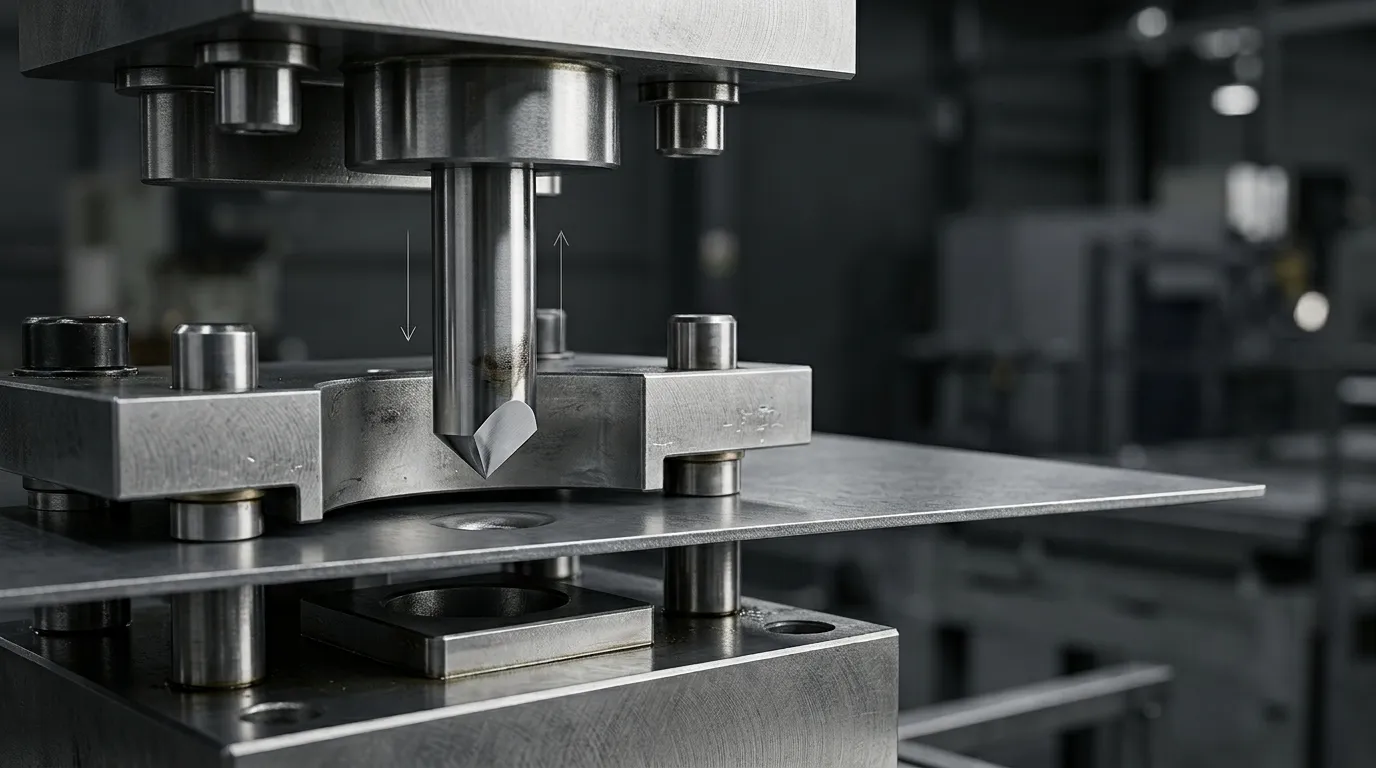
Dlaczego stal o wysokim napięciu zmienia wymagania dotyczące sworzni dziurkaczowych
Higher-strength sheet places greater demands on the punch, Przycisk, Striptizerka, System przewodników, i prasa. The punch must penetrate the sheet without deforming, survive the sudden release of stored energy as the material fractures, and withdraw without excessive adhesion or side loading.
The workpiece description should include more than “high-tensile steel.” Important inputs include:
- Exact steel grade
- Plastyczność i wytrzymałość na rozciąganie
- Grubość arkusza
- Powłoka powierzchniowa lub powłoka
- Warunki smarowania
- Rozmiar i kształt otworu
- Wymagana jakość krawędzi
- Tempo produkcji i długość serii
These factors influence cutting load, Zużycie ścierne, tarcie, irytujące, Formowanie żarna, and stripping force. Two steels with similar tensile-strength ratings can behave differently because their microstructures and surface conditions are not identical.
High-Tensile Steel, AHSS, and UHSS Are Not Interchangeable Specifications
“High-tensile steel” is a broad commercial term. Advanced high-strength steel, or AHSS, includes several material families such as dual-phase, complex-phase, and martensitic steels. UHSS generally refers to the higher-strength portion of this wider group, although terminology can vary by supplier and industry.
The label alone is not enough to select a punch. A tooling supplier needs the complete grade designation, mechanical properties, Grubość, oraz warunki powierzchniowe. Technical overviews of Zaawansowane klasyfikacje stali wysokiej wytrzymałości also show why strength numbers should be considered alongside the steel’s metallurgical type.
Wyższe obciążenia mogą powodować jednoczesne zużycie i pęknięcia
A punch used on higher-strength sheet may experience more than one failure mechanism.
A hard, wear-resistant edge can still chip if it receives uneven loading. A tougher punch may survive impact but lose dimensional accuracy through abrasive wear. Material pickup can increase friction during withdrawal, adding bending stress to a small-diameter punch.
This is why punch life cannot be predicted from hardness alone. Hardness and compressive strength help resist deformation and wear. Toughness and ductility help the tool tolerate impact, bending, stress concentrations, and crack propagation.
Zdiagnozuj tryb awarii przed zmianą materiału dziurkarki
Before upgrading the punch material, inspect the failed tool and the parts it produced. Look at the cutting edge, Skrzydło, Korpus, głowa, Materiał przyklejony, scoring direction, burr trend, and the location of any cracks.
The following table provides a practical starting point.
| Obserwowany stan | Prawdopodobny mechanizm | Pierwsze sprawdzenia | Kierunek własności lub korekty |
|---|---|---|---|
| Stopniowo zaokrąglona krawędź i rosnąca zadziorność | Zużycie ścierne | Sheet grade, Dostęp, Stan powierzchni, Długość serii | Greater wear resistance, improved finish, revised clearance or coating |
| Materiał roboczy przymocowany do dziurkarza | Zużycie lub uszkodzenie adhezji | Smarowanie, sheet coating, punch finish, withdrawal condition | Niższe tarcie, better surface finish, suitable coating or process correction |
| Brakujące małe elementy krawędzi tnącej | Edge chipping | Przebieg trasy, Dostęp, Geometria krawędzi, Obróbka cieplna | Greater toughness, lower stress concentration, improved support |
| Poważne pęknięcie lub całkowite pęknięcie | Grube pęknięcia lub pęknięcia | Boczne obciążenie, Długość bez podparcia, Wskazówki, Twardość, Geometria dziurkarki | Większa odporność na pękanie plus korekcja systemu |
| Edge rolls, mushrooms, or changes shape | Odkształcenie plastyczne | Cutting load, Twardość podłoża, Obróbka cieplna, Wytrzymałość ściskająca | Większa wytrzymałość na ściskanie lub skorygowana obróbka cieplna |
| Jedna strona szybciej się zużywa lub odpryskuje | Nierównomierne obciążenie | Die-button position, Zużycie przewodnika, Ugięcie prasy, Koncentryczność | Przywróć wyrównanie i równomierne prześwity przed zmianą materiału |
The Dyskusja o wytycznych AHSS dotyczących narzędzi i zużycia matryc separates abrasive wear, Zużycie kleju, odpryskiwanie, pękanie, and plastic deformation because they do not have the same cause or corrective action.
Zużycie ścierne, Zużycie kleju, and Galling
Abrasive wear removes punch material progressively. Common signs include edge rounding, Punktacja, Utrata wymiarowa, and a gradual increase in burr height. Hard phases in the workpiece, Skala, surface contamination, and repeated contact can contribute to this type of deterioration.
Adhesive wear involves material transfer between the sheet and punch. The workpiece may stick to the punch surface, creating pickup, smearing, lub punktacji. Severe adhesion can develop into galling, where rough transferred material increases friction and damages both surfaces.
Before specifying a harder substrate, Sprawdzone:
- Wykończenie powierzchni dziurkanej
- Rodzaj i konsystencja smaru
- Powłoka blachowa
- Prześwit od dziurka do wydruku
- Kierunek szlifowania
- Warunki rozbierania
- Uszkodzenia istniejącej powłoki
A coating may reduce friction or pickup, but it cannot compensate for severe misalignment, unstable geometry, or an unsuitable base material.
Edge Chipping, Gross Cracking, and Plastic Deformation
Edge chipping is a localized fracture. It may result from inadequate toughness, excessive edge stress, nierówny prześwit, a sharp stress concentration, słabe wsparcie, or an unsuitable heat-treatment condition.
Gross cracking affects a larger section of the punch and may lead to complete separation. Boczny ładunek, Nadmierna długość bez podparcia, Niedopasowanie, poor transitions between sections, or an excessively brittle substrate can contribute. Broader fracture causes are covered in Pęknięcie dziurkownika w matrycach tłoczących.
Plastic deformation is different. Instead of cracking, the punch permanently changes shape because the applied stress exceeds the material’s compressive capability. The edge may roll or mushroom. A tougher material is not necessarily the answer; the punch may need greater hardness, Wytrzymałość ściskająca, improved heat treatment, or reduced loading.
Dopasuj rodzinę materiałów dziurkowych do dominującego ryzyka
Material selection should begin with the property that is missing, not with a familiar grade name. The practical question is whether the application primarily needs more wear resistance, Wytrzymałość, Wytrzymałość ściskająca, Opór na drażnienie, or a balanced combination.
| Material family | Typowy kierunek selekcji | Główna zaleta | Główne ograniczenie |
| Konwencjonalna stal narzędziowa do obróbki na zimno | Umiarkowane do wysokiego zużycia przy stabilnym obciążeniu | Ustalony proces obróbki i użyteczna odporność na zużycie | Niektóre klasy mogą się odpryskiwać pod silnym uderzeniem lub zginaniem |
| Stal szybkościąca | Combined hardness, Odporność na zużycie, and improved toughness | Zrównoważona wydajność dla wielu zastosowań dziurkarskich | Wydajność nadal w dużej mierze zależy od obróbki cieplnej i geometrii |
| Stal narzędziowa do metalurgii proszkowej lub PM-HSS | Wymagające zastosowania z mieszanym ryzykiem zużycia i pęknięć | Bardziej jednolity rozkład węglika i szersze kombinacje właściwości | Wyższy koszt materiału musi być uzasadniony przez samo zastosowanie |
| Węglik | Severe abrasive wear under rigid, well-aligned conditions | Wysokie zużycie i odporność na ściskanie | Bardziej wrażliwa na uderzenia, bending, słabe wsparcie, oraz niedopasowanie |
No family is universally superior. A stable, well-supported application with gradual abrasive wear may justify a different material from a small punch that repeatedly chips under side load.
Konwencjonalna stal narzędziowa i stal szybkociętna
Conventional cold-work tool steels can provide strong wear resistance, but their toughness varies widely. A D2- or SKD11-type material may be appropriate in a stable application where abrasive wear dominates, yet it may not be the best direction for a slender punch experiencing impact or uneven loading.
High-speed steels such as M2- or SKH51-type grades are commonly considered when the application needs a stronger balance of hardness, Odporność na zużycie, i wytrzymałość. This does not make HSS automatically better. Obróbka cieplna, Średnica dziurka, Promienie przejścia, Wskazówki, and operating conditions can have more influence than the grade label alone.
SunshinePro wymienia SKH51, SKH9, and DC53 among its punch-pin material options. These are available choices, not universal recommendations for every AHSS or UHSS operation.
Stale narzędziowe do metalurgii proszkowej do mieszanych wymagań zużycia i pękania
Powder-metallurgy production can create a more uniform distribution of alloy carbides than conventional ingot processing. This may allow tool-steel grades to combine high wear resistance with better resistance to chipping or fatigue.
PM materials still have different priorities. Technical guidance may position one grade toward wear resistance and another toward toughness. Na przykład, PM-M4 is often discussed as a wear-focused option, while PM-3V is commonly considered where resistance to chipping and impact carries more weight. These are directional comparisons, not interchangeable specifications.
SunshinePro lists ASP materials among its available punch-pin options. The appropriate ASP grade and heat-treatment condition would still need to be selected from the actual workpiece, Geometria, Warunki produkcyjne, oraz historia awarii.
Kiedy karbid pomaga — i kiedy stwarza nowe ryzyka
Carbide offers high abrasive-wear resistance and compressive strength. It can be useful when the die is rigid, the punch is well supported, alignment is controlled, and progressive wear is the main problem.
Its limitations become important in shock-loaded or unstable conditions. Carbide is less tolerant of bending, edge impact, Niedopasowanie, and weak support than tougher tool-steel systems. Długi, narrow carbide punch can fail quickly if the underlying geometry and guidance are not suitable.
Production volume alone is not enough to justify carbide. The decision should also consider:
- Średnica dziurkowca i długość bez podparcia
- Warunki uderzenia i przebicia
- Sztywność
- Warunek systemu przewodnika
- Geometria krawędzi
- Wymagania dotyczące ponownego szlifowania
- Konsekwencje nagłego złamania
Sprawdź poświadczenie, Przebieg trasy, and Geometry Before Blaming the Punch Material
A premium punch material will not correct an unstable die system. Clearance, Przebieg trasy, Wskazówki, sztywność, Geometria, and stripping conditions should be checked before a substrate change is approved.
Prześwit i wyrównanie zmieniają obciążenie krawędzi tnącej
Punch-to-die clearance affects cutting force, fracture development, Formowanie żarna, Obciążenie krawędzi, and tool wear. The correct value depends on the exact sheet grade, Grubość, edge-quality target, Stan narzędzi, and operation. A single clearance percentage should not be applied to all high-tensile steels.
Uneven clearance can be more damaging than an imperfect nominal value. If one side of the punch contacts earlier, that section receives concentrated load and may wear or chip first.
Możliwe przyczyny obejmują:
- Zużyte słupki prowadzące lub tuleje
- Nieprawidłowa pozycja przycisku die
- Mechanizm uchwytu dziurkarza
- Ugięcie w tłoczeniu lub ugniatku układu
- Błąd montażu
- Lokalizowane zużycie guzików
The Przewodnik po komponentach matrycy explains how punches, Guziki, Striptizerki, Punkty przewodnika, and bushings interact within the wider die system.
Średnica, Długość bez podparcia, Stripping, and Lubrication Affect Survival
Small-diameter punches are sensitive to bending because their cross-sectional area is limited. Risk increases when the unsupported length is excessive, guidance is weak, or material pickup creates lateral force during withdrawal.
Punch geometry should therefore be reviewed as carefully as the substrate. Important details include:
- Zależność średnica do długości
- Konstrukcja głowicy i trzonka
- Promienie przejścia
- Nowoczesne przygotowanie
- Zwężenie lub zmniejszanie
- Naprowadzanie w pobliżu końca roboczego
- Wsparcie stripperów
Stripping can also become a major load event. Material adhered to the punch increases withdrawal force. If the stripper does not support the sheet evenly, the punch may bend as it retracts.
Lubrication and surface finish influence this relationship. They should be evaluated together with the workpiece coating and punch finish rather than treated as general maintenance details.
Treat Heat Treatment, Wykończenie powierzchni, and Coating as One System
A material grade does not arrive with fixed performance. Heat treatment establishes the final hardness, Wytrzymałość, Wytrzymałość ściskająca, stress condition, oraz stabilność wymiarowa. Grinding and surface finishing then influence geometry, tarcie, and the quality of the cutting edge.
Coating is the final surface intervention, not a replacement for a correctly processed substrate.
Obróbka cieplna ustala rzeczywiste właściwości dziurkacza
The same tool-steel grade can perform differently when its heat-treatment condition changes. Excessive hardness may improve wear resistance while reducing tolerance for impact or stress concentration. Insufficient hardness may allow deformation, edge rolling, or rapid wear.
A responsible specification should define:
- Jakość materiałowa
- Wymagany stan obróbki cieplnej
- Dopuszczalny zakres twardości
- Wymiary krytyczne po podświetleniu cieplnym
- Stan powierzchni
- Metoda inspekcji
- Wszelkie wymagania dotyczące szlifowania po zabiegu
SunshinePro lists vacuum heat treatment and precision grinding among its punch-pin processes. The final treatment and inspection requirements should still be agreed for the specific material and drawing.
Powłoki mogą zmniejszyć uszkodzenia powierzchni, ale nie naprawiają słabego projektu
PVD coatings can modify friction, adhesive behavior, and wear at the punch surface. They may be useful where galling, pickup, or progressive surface wear dominates.
They cannot correct:
- Niedopasowanie
- Nadmierna długość bez podparcia
- Słabe przejścia przekrojowe
- Niewystarczająca wytrzymałość podłoża
- Odkształcenie plastyczne pod powłoką
- Nieprawidłowe przepusty
- Słabe przygotowanie krawędzi
SunshinePro lists TiN and TiCN as optional punch-pin coatings. Selecting between them requires application-specific review rather than a generic life comparison.
Coating thickness must also be included in dimensional planning. Regrinding may remove the coating from the working area, requiring a decision about recoating, dimensional restoration, lub zastąpienie.
Stosuj proces wyboru dziurkacza w trybie awarii
A practical selection process should follow this order:
- Identify the workpiece completely.
Record the grade, yield and tensile strength, Grubość, surface coating, hardness data where available, and lubrication condition. - Document the punch and die geometry.
Include hole size, Średnica dziurka, head form, Całkowita długość, Długość bez podparcia, die-button opening, intended clearance, and stripper arrangement. - Klasyfikuj porażkę.
Determine whether the main problem is abrasive wear, irytujące, odpryskiwanie, pękanie, deformacja, or uneven loading. - Correct system problems first.
Check alignment, Zużycie przewodnika, die-button condition, Dostęp, Ugięcie prasy, Zdejmowanie, oraz smarowanie. - Choose the required property direction.
Decide whether the application needs more wear resistance, Wytrzymałość, Wytrzymałość ściskająca, niższe tarcie, or a balanced combination. - Select the substrate and heat-treatment condition together.
Do not choose a grade without defining how it will be processed. - Add finish and coating only where they address the failure mechanism.
Surface treatment should support the substrate and process, not hide an unresolved design problem. - Validate under controlled production conditions.
Monitor burr growth, Materiał przechwyt, Zmiana wymiarowa, odpryskiwanie, Interwały konserwacji, and the condition of the die button.
Consider three common patterns:
- A small punch with repeated edge chipping usually requires alignment and unsupported-length checks before simply increasing hardness.
- A punch with material pickup on coated sheet may need better lubrication, Zakończenie, or coating rather than a tougher core material.
- A stable high-volume operation showing gradual edge rounding may justify greater abrasive-wear resistance once clearance and alignment are confirmed.
The best option is the one that controls the actual failure at an acceptable cost per accepted part, not necessarily the punch with the highest initial material cost or hardness.
Przygotuj dane aplikacyjne przed złożeniem wniosku o niestandardowe piny do dziurkowania
A drawing provides dimensions, but it may not explain why the existing punch is failing. A useful technical review should include workpiece data, tooling details, process conditions, Dowody awarii, and acceptance requirements.
Dane do wysłania razem z rysunkiem lub próbką nieudanej dziurkowanej
Dostarczaj:
Informacje o obrabianym materiale
- Exact steel grade
- Plastyczność i wytrzymałość na rozciąganie
- Grubość arkusza
- Powłoka powierzchniowa
- Smar i metoda aplikacji
Informacje o dziurku i matrycy
- Średnica i profil dziurkowca
- Długość całkowita i niewspierana
- Geometria głowicy i trzonka
- Otwieranie na przycisk kości
- Planowane przepusty
- Układ taśmowy i naprowadzający
- Istniejący materiał dziurkowy i twardość
- Obecna powłoka i wykończenie powierzchni
Informacje o produkcji
- Typ prasy i odpowiednie warunki pracy
- Liczba uderzeń na minutę
- Liczba uderzeń na punkt
- Oczekiwany wolumen produkcji
- Historia ponownego szlifowania
- Planowany interwał konserwacji
Dowody awarii
- Wyraźne zdjęcia
- Lokalizacja pęknięcia lub odprysku
- Odbiór materiału lub punktacja
- Trend zadziorny
- Strata wymiarowa
- Częstotliwość awarii
- Niezależnie od tego, czy uszkodzenie nastąpi podczas penetracji czy wycofania
SunshinePro states that punch diameter, Długość, Kształt głowy, Materiał, and coating can be customized. To Strona produktu z dziurkaczowymi sworzniami also lists SKH51, SKH9, DC53, ASP, Węglik, precyzyjne szlifowanie, Obróbka próżniowa, TiN, and TiCN among available options.
Dokumentacja i weryfikacja przed rozpoczęciem produkcji
Przed zatwierdzeniem produkcji, define which records and acceptance criteria are required. These may include:
- Tożsamość materiału lub certyfikat
- Uzgodniony zakres twardości
- Krytyczna inspekcja wymiarowa
- Wymagania dotyczące wykończenia powierzchni
- Rodzaj i grubość powłoki
- Wymiary po powleknięciu
- Drawing revision
- Proces zatwierdzania próbek
- Granice zadzioru i jakości krawędzi
- Oczekiwania dotyczące ponownego szlifowania i ponownego nakładania
SunshinePro’s product page lists dimensional capability up to ±0.002 mm and a hardness range of HRC 58–68. These should be treated as listed capability ranges, not universal specifications. Achievable tolerances and hardness depend on the selected material, Geometria, Obróbka cieplna, Powłoka, rysunek, and inspection agreement.
For an application review, send the drawing together with the sheet specification, Warunki eksploatacji, and failure evidence through the Strona kontaktowa SunshinePro. This gives the supplier enough context to evaluate the punch material, Geometria, Obróbka cieplna, Zakończenie, and coating as one system rather than recommending a grade from the workpiece name alone.
Udostępnij:



Napisane przez Sunshine
W Sunshine, Jesteśmy profesjonalnym producentem i dostawcą komponentów do precyzyjnych form, oferując szeroką gamę produktów do tłoczenia i formowania wtryskowego. Naszym głównym celem są formy do dziurkania, Sworznie wyrzutowe i tuleje, oraz słupy i tuleje. Dzięki zaawansowanej obróbki CNC, Ścisła kontrola jakości, oraz silne możliwości produkcyjne, Zapewniamy niezawodność, Części o wysokiej precyzji, wraz ze standardowymi komponentami dostępnymi na stanie, zapewniającymi szybkie i efektywne globalne dostawy.
WIADOMOŚCI
UZYSKAJ USŁUGĘ
Z wysokiej jakości częściami dostosowanymi do każdego budżetu oraz przyjaznym personelem przeszkolonym, by Twoja wizyta była poinformowana i bezproblemowa.
