



Formowanie wtryskowe samochodów: Wymagania dotyczące narzędzi dla trwałych części plastikowych
Automotive injection molding requires tooling that can maintain dimensional stability, cosmetic consistency, and repeatable part quality through long production runs. Automotive molds face thermal cycling, vibration-related stress, Materiały ścierne, and tight tolerance requirements. Narzędzia hartowanej stali, balanced cooling channels, proper venting, and preventive maintenance help manufacturers produce durable automotive plastic parts with stable surface finishes and longer mold life.
Automotive suppliers cannot treat vehicle parts like standard consumer plastics. A dashboard panel, grille, or under-hood housing may go through years of heat, drgania, Ekspozycja na UV, oraz naprężenia mechaniczne. Tooling decisions directly affect whether those parts stay dimensionally stable and visually consistent after hundreds of thousands of cycles.
What makes automotive injection molding different from standard plastic molding?
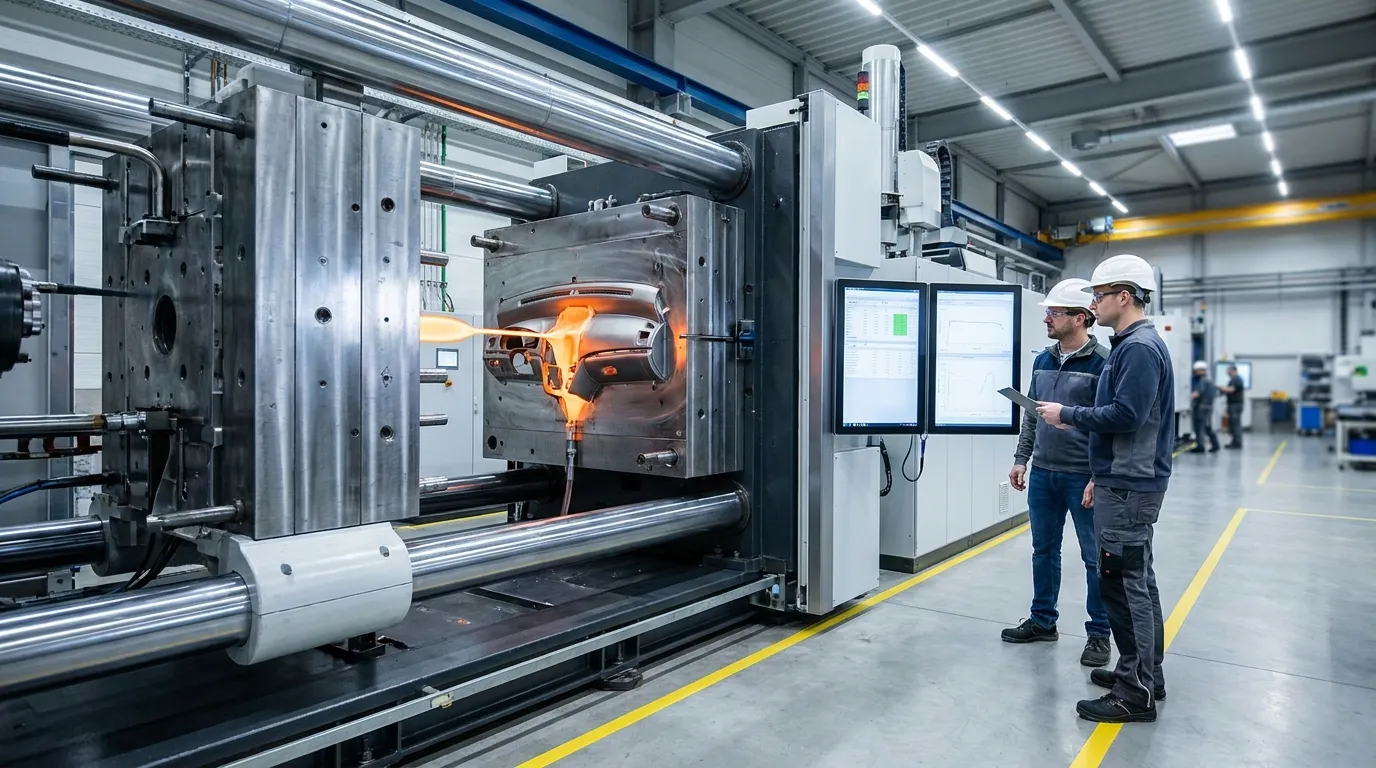
Automotive injection molding requires stronger tooling because vehicle parts must survive heat, drgania, Ekspozycja na UV, and long production runs without losing dimensional accuracy or cosmetic quality. Standard consumer-product molds usually face lower stress and shorter production demands.
Automotive parts often stay in service for years under changing temperatures and constant vibration. Interior trim pieces must fit tightly without rattling. Exterior components need stable surface finishes even after long UV exposure. Under-hood parts may experience repeated thermal cycling that pushes both the resin and the mold harder than standard commercial applications.
Production volume also changes the tooling strategy. Automotive programs commonly run for hundreds of thousands or even millions of cycles. Softer tooling materials may wear too quickly under those conditions, especially when using glass-filled engineering plastics.
| Standardowe formowanie plastiku | Formowanie wtryskowe samochodów |
|---|---|
| Niższe wolumeny produkcji | Serie produkcji dużych serii |
| Podstawowe standardy kosmetyczne | Ścisła spójność wykończenia powierzchni |
| Ograniczona ekspozycja termiczna | Powtarzające się cykle termiczne |
| Wymagania o niższych wymiarach | Ścisłe tolerancje montażowe |
| Krótsza żywotność produktu | Długoterminowe oczekiwania dotyczące trwałości |
This is why many automotive suppliers invest heavily in hardened tooling, Sterowanie procesem, and preventive maintenance. Według Intertek, automotive plastic components often require extensive validation and testing to maintain quality standards across production.
If you need a broader overview of mold construction, the Podstawy projektowania form page explains the core structure behind injection mold systems.
Which automotive parts place the highest demands on injection molds?
Automotive parts exposed to heat, drgania, UV light, or cosmetic inspection place the greatest demands on injection molds. Panele rozdzielcze, Grille, Obudowy lamp, and under-hood components require stable tooling that can maintain tight tolerances across long production runs.
Not every automotive component stresses a mold equally. Large cosmetic panels often create the biggest challenges because they combine appearance requirements with dimensional accuracy. Even a small amount of warpage can create fitment problems during assembly.
Lamp housings are another demanding application. Poor cavity polishing or inconsistent cooling can create gloss variation that becomes visible immediately under light reflection. Exterior grilles and trim pieces also need stable surface texture retention throughout the mold lifecycle.
| Część samochodowa | Główne wyzwanie narzędziowe |
|---|---|
| Panele deski rozdzielczej | Kontrola warpage |
| Obudowy lamp | Spójność połysku |
| Grille zewnętrzne | Jakość powierzchni związana z UV |
| Obudowy pod maską | Opór termiczny |
| Panele wykończeniowe wnętrza | Dopasowanie wymiarowe |
| Komponenty HVAC | Powtarzalność w dłuższym okresie |
A dashboard molding project is a good example. Uneven cooling channels can create shrinkage differences across the part surface. The result may look flat at first, then distort slightly after installation. That small dimensional shift often causes alignment issues during vehicle assembly.
Manufacturers working across different industries often apply similar precision principles. The Zastosowania w formach wtryskowych resource shows how tooling requirements change between product categories.
Why do mold steel selection and hardness matter in automotive production?
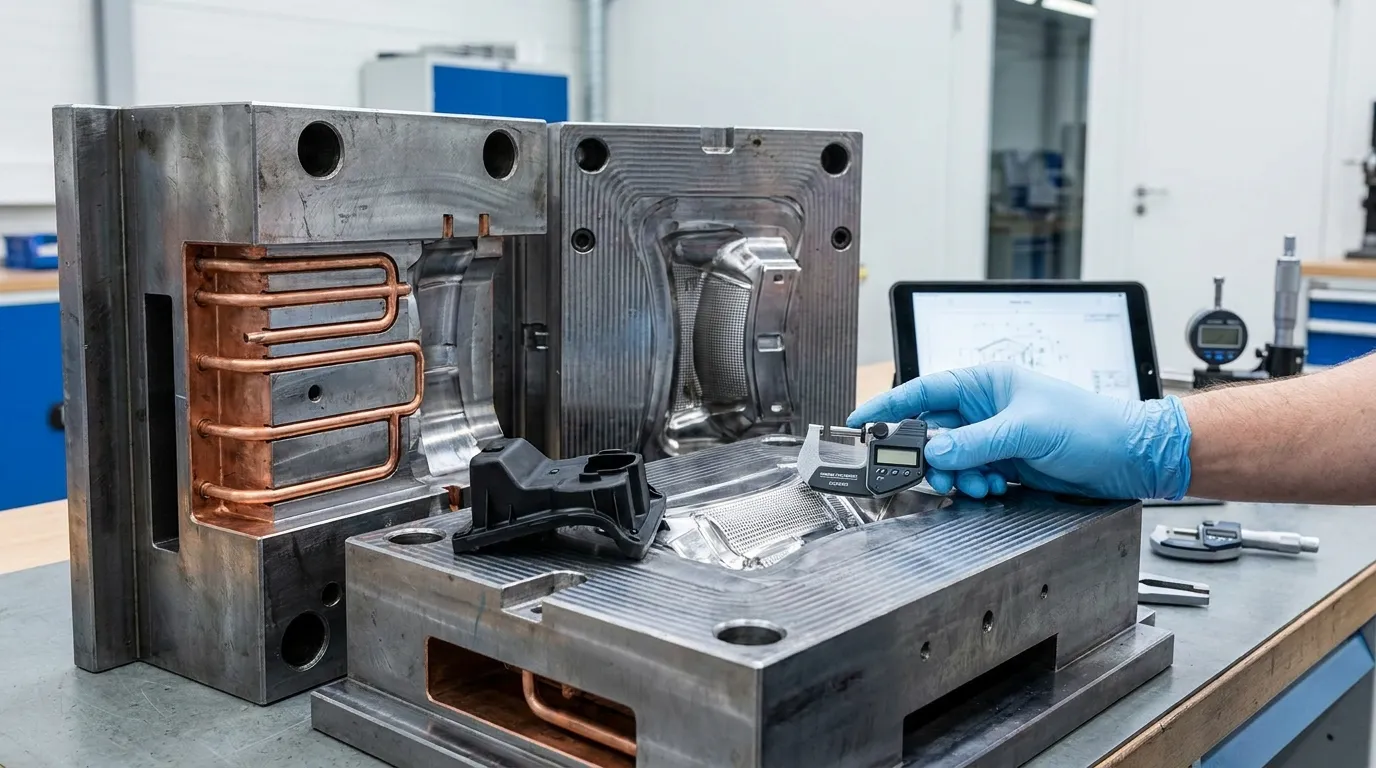
Mold steel selection affects wear resistance, cavity stability, surface finish retention, oraz długoterminową spójność produkcji. Automotive programs with high volumes or abrasive resins usually require hardened steel tooling instead of softer aluminum molds.
Tooling material directly affects how long a mold can maintain quality standards. Automotive molds frequently run abrasive materials such as glass-filled nylon, which can wear softer cavity surfaces quickly. Once cavity wear starts, dimensional drift and cosmetic defects become harder to control.
Hardened steel tooling costs more upfront, but it usually performs better for long automotive programs. It handles repeated thermal cycling more consistently and maintains cavity precision over larger production volumes.
| Materiały narzędziowe | Najlepszy przypadek użycia | Główne ograniczenie |
|---|---|---|
| Narzędzia aluminiowe | Prototyp i krótkie serie | Szybsze zużycie |
| Stal wstępnie hartowana | Produkcja średnia | Umiarkowana odporność na zużycie |
| Hartowana stal | Długie programy motoryzacyjne | Wyższy koszt początkowy |
Gdy narzędzia aluminiowe nadal mają sens
Aluminum tooling is not always the wrong choice. It works well for prototype validation, Narzędzia mostowe, and low-volume production where lead time matters more than extreme mold lifespan.
That said, low tooling cost can become expensive later if the mold cannot maintain dimensional consistency. A softer mold running glass-filled resin may require repeated repairs, re-polishing, or cavity corrections much earlier than expected.
A supplier that understands long-term tooling performance should explain these tradeoffs clearly instead of defaulting to the cheapest option. The Przewodnik po komponentach form provides a broader look at the components that affect tooling durability.
How do automotive manufacturers maintain dimensional stability in molded parts?
Dimensional stability in automotive injection molding depends on balanced cooling, stable cavity temperatures, controlled shrinkage, and repeatable process settings. Poor tooling design can cause warpage, fitment issues, and inconsistent assembly performance.
Automotive assemblies leave little room for dimensional variation. Elementy wykończenia wewnętrzne, HVAC housings, and console components often need to align precisely with surrounding parts. Even small dimensional movement can create visible gaps or assembly stress.
Cooling design plays a major role in dimensional control. If one area of the cavity cools faster than another, the part may shrink unevenly. This is a common cause of warpage in large automotive panels.
Typowe przyczyny odkształcenia w częściach samochodowych
- Nierówny układ kanału chłodzenia
- Złe rozmieszczenie bramek
- Nieregularne kurczenie się żywicy
- Nadmierne ciśnienie wtrysku
- Niestabilna kontrola temperatury formy
A dashboard warpage issue illustrates the problem well. One supplier used uneven cooling channels near the center of a large panel. The part initially passed inspection, but slight dimensional movement appeared after installation. The issue traced back to inconsistent cooling rates across the cavity.
Manufacturers also use mold-flow analysis to predict shrinkage and filling behavior before production begins. Stable process settings help maintain repeatability after the tool moves into long production cycles.
| Współczynnik stabilności wymiarowej | Dlaczego to ważne |
|---|---|
| Zrównoważone chłodzenie | Zmniejsza nierównomierne kurczenie |
| Stabilna temperatura wnęki | Poprawia powtarzalność |
| Kontrolowane rozmieszczenie bramek | Zmniejsza naprężenia wewnętrzne |
| Spójne ustawienia procesów | Utrzymuje wymiary części |
| Wybór żywicy | Wpływa na zachowanie kurczenia się |
Companies producing tight-tolerance parts in other industries face similar challenges. The Precyzja formy urządzenia page shows how precision tooling practices support dimensional consistency.
What tooling features improve surface finish and cosmetic quality?
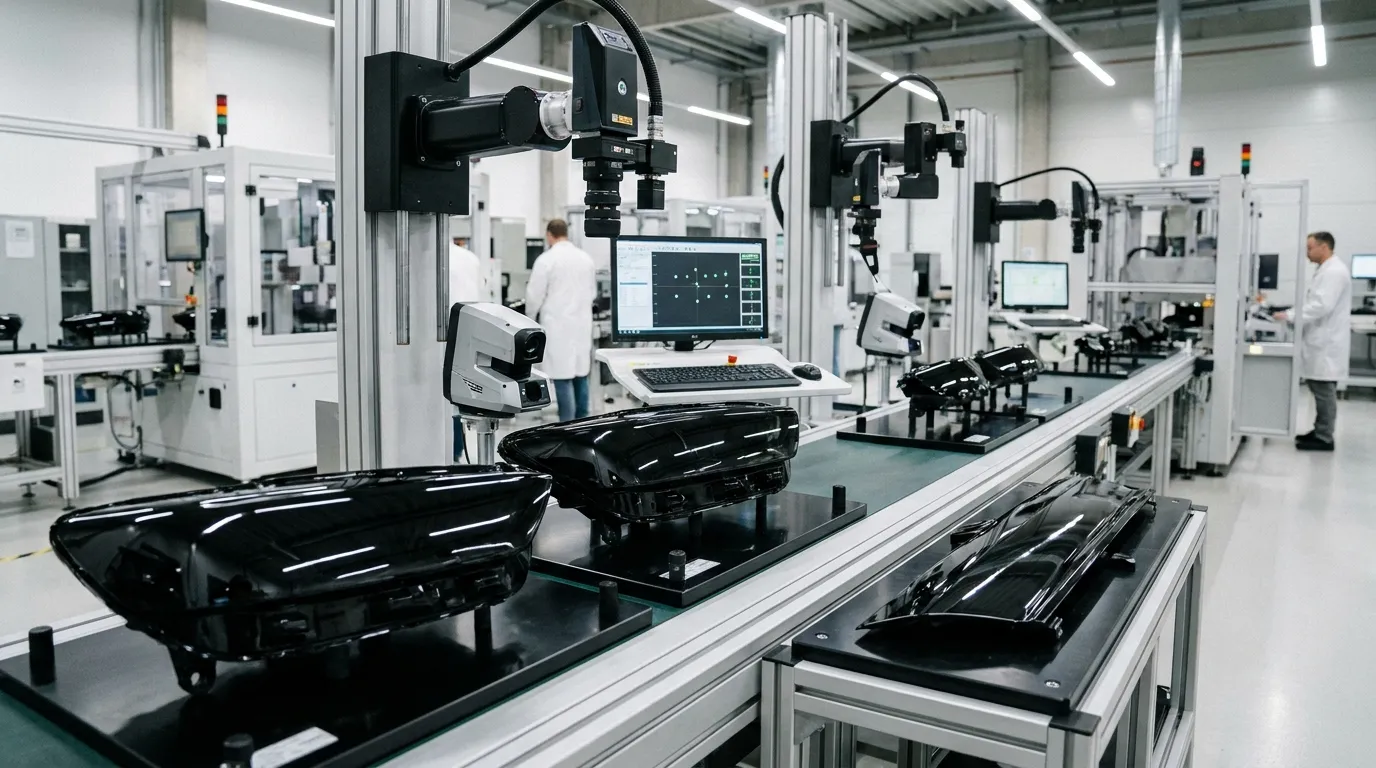
Automotive surface quality depends heavily on tooling precision. Proper polishing, Ewoluacja, cavity alignment, and gate positioning help manufacturers reduce weld lines, gloss variation, and visible cosmetic defects across large production runs.
Cosmetic automotive parts require stable tooling surfaces. Poor polishing can create texture inconsistency, while weak venting may trap gases and leave visible marks on finished components.
Lamp housings provide a clear example. A supplier may choose a premium resin, but weak cavity polishing can still create uneven gloss reflection across the part surface. In automotive applications, even small cosmetic variation becomes noticeable under direct lighting.
Lista kontrolna wykończenia powierzchni
- Utrzymuj stałe standardy polerowania wnęk
- Projektuj wentylację w celu zmniejszenia śladów uwięzionych gazów
- Bramki pozycyjne, aby zminimalizować widoczność linii spawiania
- Zużycie komory monitorów podczas długich serii produkcyjnych
- Kontroluj temperaturę formy dla stabilnego połysku
Surface finish problems are often tooling problems, not material problems. A well-designed mold can improve appearance consistency even when production volume increases significantly.
For industries that also require tight cosmetic control, the Narzędzia do urządzeń plastikowych resource shows how precision tooling supports clean surface quality.
How does production volume affect automotive tooling strategy?
Production volume changes nearly every tooling decision in automotive injection molding. Low-volume programs may justify softer tooling, while long-run automotive production usually requires hardened steel, preventive maintenance planning, and stable multi-cavity performance.
A prototype tool and a million-cycle automotive production mold serve very different purposes. Short-run programs often focus on speed and lower upfront cost. Long-run automotive programs prioritize consistency and predictable maintenance intervals.
Multi-cavity tooling becomes more important as production demand increases. When cavity balancing is poor, one cavity may fill differently from another. That variation can create dimensional inconsistency across the same production run.
Gdy konieczne staje się wielokomorowe narzędzia
Multi-cavity molds make sense when production demand is high enough to justify the added tooling complexity. They improve output efficiency, but they also increase the need for balanced flow paths and stable process control.
A trim panel production project highlights this issue well. One cavity produced slightly different shrinkage because the flow path was less balanced. The result was inconsistent fitment during assembly checks.
Tabela decyzyjna o narzędziach motoryzacyjnych
| Produkcja | Zalecane narzędzia | Typowe życie pleśni | Powszechne zastosowanie | Częstotliwość konserwacji |
|---|---|---|---|---|
| Under 10,000 Części | Narzędzia aluminiowe | Krótkoterminowe | Walidacja prototypu | Low |
| 10,000 do 100,000 Części | Stal wstępnie hartowana | Średnioterminowe | Produkcja mostków | Umiarkowany |
| 100,000Części | Hartowana stal | Długoterminowo | Pełna produkcja motoryzacka | Planowana konserwacja profilaktyczna |
Tooling revisions can also extend lead times significantly. Według Evok Polytech oraz Ulitech, design changes during tooling development often increase production delays and adjustment costs.
What shortens the lifespan of automotive injection molds?
Automotive injection molds wear out faster when abrasive resins, poor maintenance practices, excessive injection pressure, or uncontrolled thermal cycling damage cavity surfaces and critical mold components.
Automotive molds operate under demanding conditions for long periods. Glass-filled engineering plastics are especially hard on cavity surfaces because the reinforcing fibers gradually erode softer tooling materials.
Thermal cycling creates another long-term issue. Repeated heating and cooling can affect cavity stability, especially if the mold lacks proper temperature management. Z czasem, this may reduce dimensional accuracy or create flash issues around part edges.
Lista kontrolna dotycząca awarii pleśni w samochodach
| Źródło zużycia | Widoczny objaw | Prawdopodobna przyczyna | Działania naprawcze | Priorytet utrzymania |
|---|---|---|---|---|
| Zużycie żywicy ściernej | Dryf wymiarowy | Materiały wypełnione szkłem | Utwardzenie powierzchni wnęk | Wysoko |
| Słaba konserwacja wentylacji | Ślady spaleń | Łapanie gazu | Czyste kanały wentylacyjne | Wysoko |
| Nadmierne ciśnienie wtrysku | Formacja błyskowa | Nierównowaga procesów | Dostosuj ustawienia procesu | Medium |
| Naprężenie termiczne cykliczne | Pękanie powierzchniowe | Niestabilna kontrola temperatury | Poprawa zarządzania chłodzeniem | Wysoko |
| Zużycie powłok wnękowych | Niespójność połysku | Długie serie produkcji | Ponowne polerowanie powierzchni wnęk | Medium |
Preventive maintenance matters more in automotive molding than many buyers realize. Według Escatec, tooling lifespan depends heavily on maintenance quality, operating conditions, oraz dobór materiałów.
Jak kupujący powinni ocenić dostawcę formowania wtryskowego dla samochodów?
Choosing the right supplier requires more than comparing tooling quotes. Automotive programs need stable production systems, long-term maintenance capability, and consistent quality control.
A supplier should be able to explain how they manage dimensional stability, cavity wear, Równowaga chłodzenia, and preventive maintenance. If those conversations stay vague, the tooling strategy may not be mature enough for demanding automotive programs.
Pytania, które warto zadać przed zatwierdzeniem narzędzi
- What mold steel is recommended, and why?
- How will the supplier manage cavity wear?
- What maintenance schedule is planned?
- Has mold-flow analysis been completed?
- How are dimensional tolerances verified during production?
A low tooling quote is not always the safest choice. Some suppliers reduce cost by using softer tooling materials or simplifying cooling design. That may work for short runs, but long automotive programs often expose those compromises later.
Buyers should also look for evidence of precision manufacturing discipline. Suppliers serving industries with tight tolerance requirements often develop stronger process controls. The Proces precyzyjnej produkcji page provides a useful example of how structured manufacturing practices support consistency.
Poprawne wykonanie kolejnego kroku
Automotive injection molding depends heavily on tooling quality, especially when parts must maintain appearance, Stabilność wymiarowa, and long-term durability across large production runs. Wybór stali formowej, Równowaga chłodzenia, Planowanie utrzymania, and cavity design all affect the final result.
Before approving a new automotive program, review how the supplier handles wear resistance, Sterowanie procesem, and preventive maintenance. A stronger tooling strategy usually costs less over the full life of the program because it reduces rework, dryf wymiarowy, and production interruptions.
Najczęściej zadawane pytania
What is automotive injection molding?
Automotive injection molding is a manufacturing process that forms vehicle plastic parts by injecting molten resin into precision molds. It is commonly used for dashboards, Panele wykończeniowe, Obudowy lamp, Grille, and structural plastic components that require repeatable quality.
What plastics are commonly used in automotive injection molding?
Common automotive molding materials include ABS, Polipropylen, Nylon, Poliwęglan, oraz tworzywa sztuczne inżynierskie wypełnione szkłem. Material choice depends on heat resistance, Wytrzymałość uderzeniowa, cosmetic quality, and dimensional stability requirements.
Jak długo wytrzymują formy wtryskowe samochodowe?
Automotive injection molds can last from hundreds of thousands to more than one million cycles depending on mold steel quality, Praktyki konserwacyjne, Ścierność żywicy, oraz warunki eksploatacji. Hardened steel tooling usually provides the longest service life.
Why is hardened steel used for automotive molds?
Hardened steel is used because automotive production often involves high volumes, Materiały ścierne, and strict dimensional requirements. Poprawia odporność na zużycie, cavity stability, and long-term surface finish consistency.
What causes warpage in automotive molded parts?
Warpage zwykle powstaje z powodu nierównomiernego chłodzenia, Słabe umiejscowienie bramek, inconsistent material shrinkage, or unstable process settings. Balanced cooling channels and controlled mold temperatures help reduce distortion.
Które części samochodowe są najczęściej formowane wtryskowo.?
Common injection molded automotive parts include dashboards, Zderzaki, Panele wykończeniowe, Grille, Obudowy lamp, Komponenty HVAC, and interior consoles. Many modern vehicles rely heavily on molded plastic components to reduce weight and improve manufacturing efficiency.
Udostępnij:



Napisane przez Sunshine
W Sunshine, Jesteśmy profesjonalnym producentem i dostawcą komponentów do precyzyjnych form, oferując szeroką gamę produktów do tłoczenia i formowania wtryskowego. Naszym głównym celem są formy do dziurkania, Sworznie wyrzutowe i tuleje, oraz słupy i tuleje. Dzięki zaawansowanej obróbki CNC, Ścisła kontrola jakości, oraz silne możliwości produkcyjne, Zapewniamy niezawodność, Części o wysokiej precyzji, wraz ze standardowymi komponentami dostępnymi na stanie, zapewniającymi szybkie i efektywne globalne dostawy.
WIADOMOŚCI
UZYSKAJ USŁUGĘ
Z wysokiej jakości częściami dostosowanymi do każdego budżetu oraz przyjaznym personelem przeszkolonym, by Twoja wizyta była poinformowana i bezproblemowa.
