



Sworznie do wykrawania ze stali narzędziowej z węglika czy narzędzi: Żywotność narzędzi, Ryzyko, oraz koszt
Carbide does not automatically make a better punch pin, and tool steel is not always the cheaper long-term choice. Carbide is usually the stronger candidate when gradual abrasive wear, dryf wymiarowy, and frequent sharpening limit production. Tool steel is often safer when the punch faces impact, bending, Boczny ładunek, uncertain alignment, or frequent design changes.
The right choice depends on how the current punch fails and how much that failure costs. Material selection is only one part of the wider die decision covered in this Przewodnik po formach wybicia (wnioskowane). Proszę, the focus is narrower: selecting between cemented-carbide and tool-steel punch pins based on tool life, Ryzyko pęknięcia, Konserwacja, and cost per accepted part.
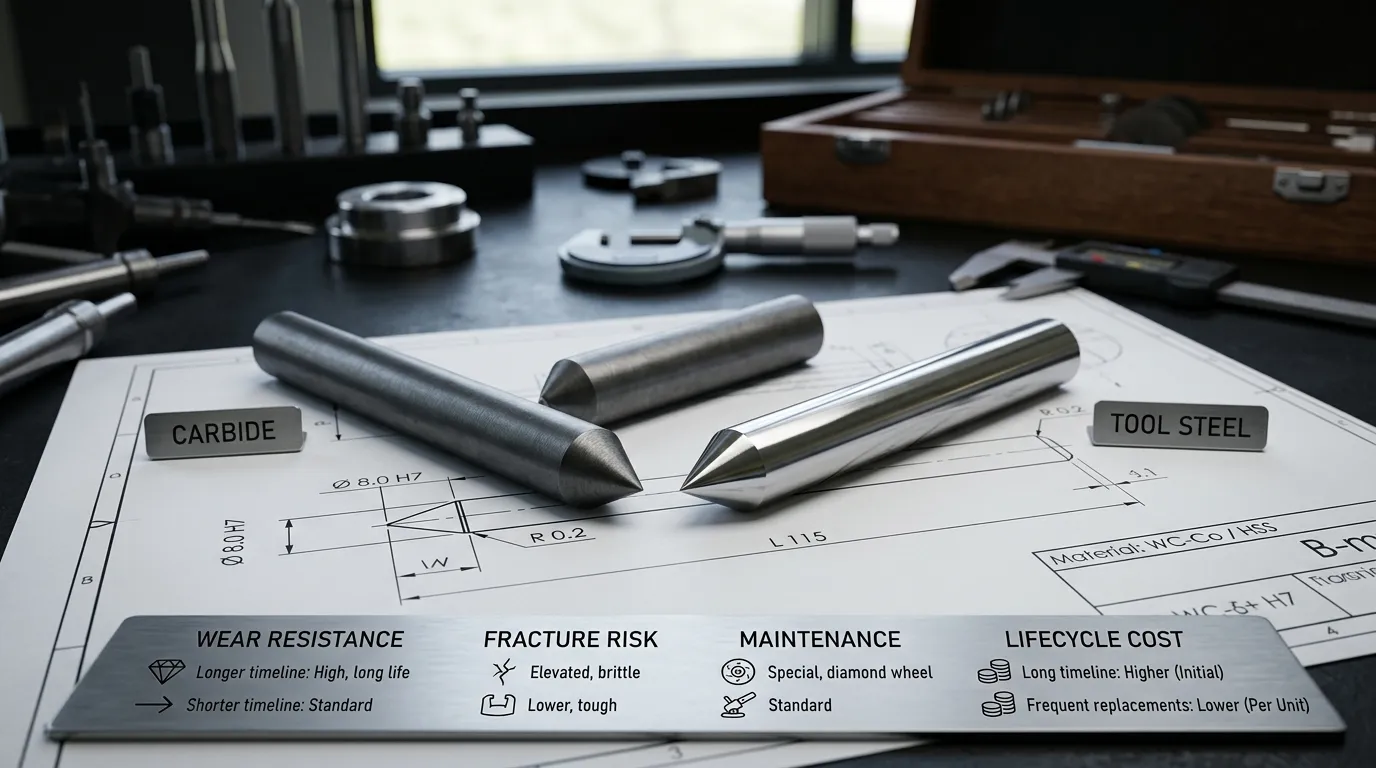
Sworznie do wykonywania ze stali narzędziowej – na pierwszy rzut oka
| Czynnik porównawczy | Sworzeń wybijający z węglika cementowego | Sworzeń narzędziowy do wykonywania stali narzędziowej |
|---|---|---|
| Odporność na zużycie | Zazwyczaj wyższe, especially in abrasive and stable applications | To w dużej mierze zależy od rodzaju stali i obróbki cieplnej |
| Zatrzymanie krawędzi | Mogą dłużej utrzymywać wymiary i stan nowoczesności, gdy zużycie kontroluje awarię | Może wymagać częstszego ostrzenia w warunkach silnego zużycia |
| Odporność na odpryski i pęknięcia | Bardziej wrażliwa na uderzenia, Boczny ładunek, and stress concentration | Generally more forgiving under shock, bending, and unstable conditions |
| Wymagania dotyczące wyrównania | Requires accurate guidance, Wsparcie, and uniform clearance | Zazwyczaj lepiej toleruje drobne zmiany operacyjne |
| Przydatność geometryczna | Risk increases with slender sections, Długość bez podparcia, and abrupt transitions | Często preferowane do trudnych lub podatnych na deformacje geometrii |
| Ponowne szlifowanie | Possible, but normally requires suitable diamond-grinding equipment and experience | Zazwyczaj łatwiej jest to przeszlifować lub zmodyfikować w tradycyjnym pracowni narzędzi |
| Koszt początkowy | Zazwyczaj wyższe | Zazwyczaj niżej, though premium HSS and PM grades can narrow the difference |
| Najlepsze dopasowanie | Stabilność, repetitive, wear-dominated production | Impact-prone, changeable, short-run, or fracture-sensitive production |
| Test ekonomiczny | Zmniejszone przerwy w obsłudze muszą uzasadniać wyższe koszty zakupu i utrzymania | Niższe pozyskanie i łatwiejsza konserwacja muszą zrekompensować krótsze interwały serwisowe |
These are directional differences, not guaranteed outcomes. Klasa węglika, Stalowy gatunek, Geometria dziurkarki, Materiał obrabianego, Stan, Dostęp, Smarowanie, and maintenance practices can change the result.
Co oznaczają "węglik" i "stal narzędziowa" w tym porównaniu
The comparison is between punch pins made from cemented tungsten carbide and punches made from hardened tool steel. A steel punch with a thin surface coating is not the same as a solid or predominantly carbide punch.
The term “tool steel” also covers several material families. A conventional D2- or SKD11-type punch does not offer the same performance balance as high-speed steel or a powder-metallurgy tool steel.
Cemented Carbide Is a Grade Family, Not One Fixed Material
Cemented carbide is a composite material. Hard tungsten-carbide particles provide much of its hardness and wear resistance, while a metallic binder holds those particles together and contributes toughness.
Według Techniczne wyjaśnienie węglika cementowego CERATIZIT, binder content and carbide grain size are two major variables controlling material properties. This means that specifying only “tungsten carbide” is incomplete.
A grade selected for maximum wear resistance may not provide the best resistance to chipping. A tougher carbide grade may survive impact or interrupted loading better, but it may not retain its edge as long in a purely abrasive application.
A responsible carbide specification should therefore consider:
- Zawartość segregatora
- Klasa wielkości ziaren węglika
- Wymagana odporność na zużycie
- Oczekiwane obciążenie uderzeniowe i zginające
- Przekrój wybitkowy i długość bez podparcia
- Materiał i stan powierzchni obrabianego przedmiotu
Tool Steel Includes Conventional, HSS, and PM Options
Tool steel should not be treated as one low-cost, low-performance category.
Conventional cold-work grades such as D2 or SKD11 are widely associated with good abrasive wear resistance and compressive strength. They can work well where loads are controlled and the geometry is sufficiently supported. Their suitability becomes less certain when severe chipping or shock resistance is required.
Stal szybkościąca, including M2- or SKH51-type grades, is also part of the tool-steel family. It generally offers a different balance of wear resistance, Wytrzymałość, and regrindability from conventional cold-work steel.
Powder-metallurgy tool steels can provide another intermediate option. Their finer and more uniform structure may improve the balance between wear resistance and toughness compared with conventional grades. The Dyskusja o wytycznych AHSS dotyczących narzędzi i zużycia matryc notes that tool selection must account for wear, shock resistance, sztywność, Wytrzymałość, and the actual forming or cutting conditions.
Heat treatment remains critical for every steel option. The grade name alone does not establish final punch performance.
Which Material Delivers Longer Punch-Pin Life?
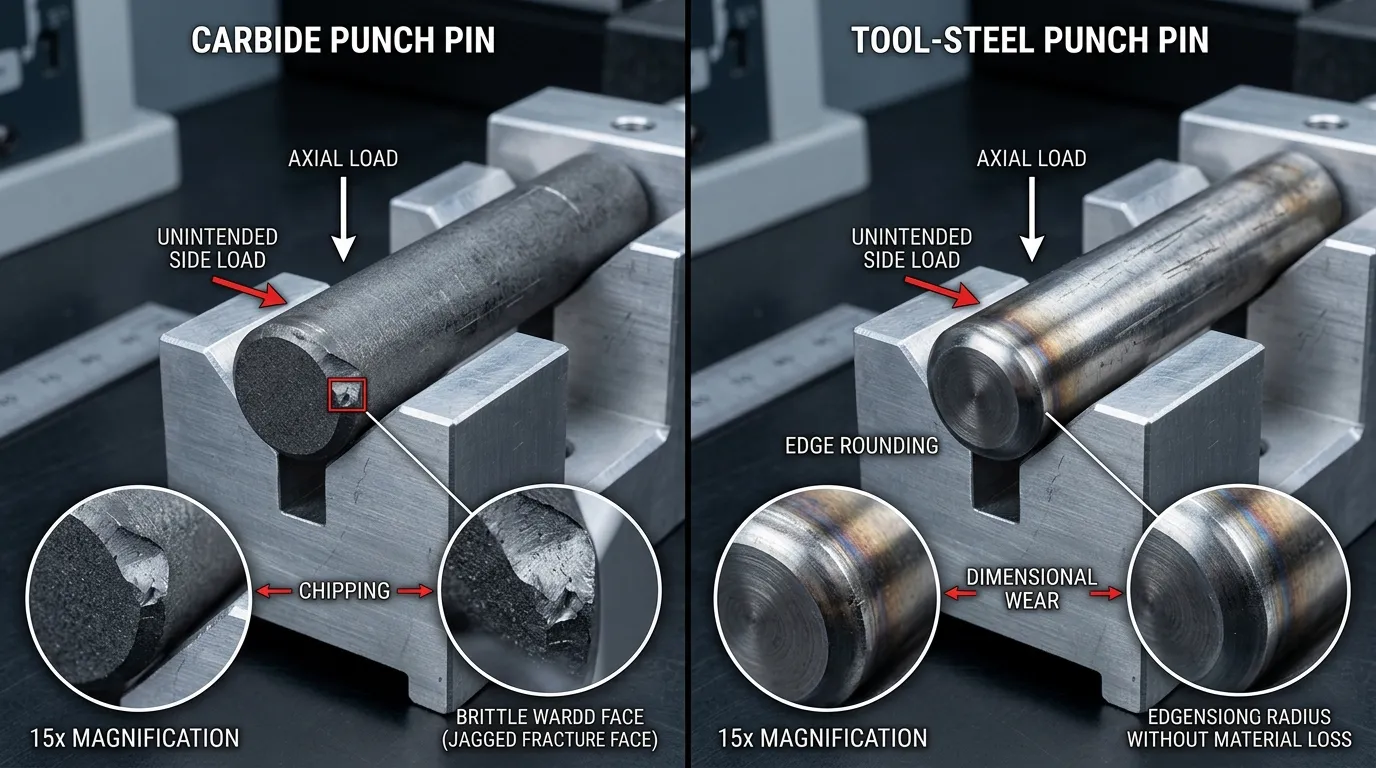
Carbide can deliver a much longer service interval when abrasive wear is the main reason the punch leaves production. It may not last longer when the real problem is chipping, pękanie, bending, Niedopasowanie, or unstable stripping.
Tool life should therefore be connected to a defined failure mode rather than a generic number of strokes.
Carbide ma najsilniejszą obudowę, gdy zużycie kontroluje awarie
Carbide is a strong candidate when the punch gradually loses its cutting profile instead of breaking suddenly.
Typical wear-dominated symptoms include:
- Progresywne zaokrąglanie krawędzi
- Zwiększanie wysokości zadziorów
- Stopniowy dryf wielkości otworów lub cechy
- Częste zaplanowane ostrzenie
- Zużycie powierzchni bez poważnych odprysk krawędzi
- Stała awaria po podobnych interwałach produkcyjnych
These conditions allow carbide’s wear resistance to create measurable value. The benefit may appear as longer intervals between service, more stable dimensions, fewer tool changes, or lower inspection and adjustment demand.
The application must still be mechanically stable. High wear resistance cannot compensate for uneven clearance, Słabe wskazówki, or a punch that bends during entry.
Stal narzędziowa może wytrzymać dłużej, gdy pęknięcia kontrolują uszkodzenie
A tool-steel punch may be more reliable when sudden damage ends the tool’s service life.
Warning signs include:
- Odpryszczone krawędzie tnące
- Pęknięcia w pobliżu zmiany średnicy
- Całkowite złamanie uderzenia
- Powtarzające się zginanie lub odchylanie
- Nierówne zużycie po jednej stronie
- Uszkodzenia podczas wyciągania z prześcieradła
- Awarie występujące w nieregularnych odstępach czasu
In these conditions, additional hardness may not solve the problem. The punch may need greater toughness, Ulepszone wsparcie, corrected alignment, a different transition radius, or a revised stripper arrangement.
Material-related fracture is only one part of the diagnosis. Dedykowany przewodnik do Pęknięcie dziurkownika w matrycach tłoczących covers the wider causes and corrective actions.
Zdefiniuj żywotność narzędzia przed porównaniem materiałów
“Longer life” has little meaning unless the endpoint is defined.
Możliwe punkty końcowe to:
- Maksymalny dopuszczalny zadziar
- Średnica otworu lub tolerancja profilu
- Limit defektów powierzchniowych
- Pierwszy widoczny chip krawędziowy
- Katastrofalne pęknięcia
- Zaplanowany interwał ostrzenia
- Liczba zatwierdzonych części przed służbą
Accepted parts are usually a better comparison measure than raw press strokes. A punch may complete many strokes while producing parts that no longer meet the drawing or burr requirement.
The same endpoint must be used for both materials. Comparing a steel punch until sharpening with a carbide punch until complete fracture produces a misleading result.
Dlaczego węglik może wytrzymać dłużej — lub szybciej się psuć
Carbide performs best when the die system keeps the punch under controlled, predominantly axial loading. Its wear advantage becomes less useful when the punch is exposed to bending, Nierówny kontakt, or sudden impact.
Przebieg trasy, Clearance, and Guide Condition
A punch should enter the die opening concentrically. Worn guide posts, loose bushings, Ruch płyty, holder runout, or uneven clearance can move the load toward one side of the cutting edge.
That local load increases stress even when the average punching force appears acceptable. A steel punch may deflect or wear under these conditions. A carbide punch may chip or fracture with less visible warning.
SunshinePro's Przewodnik po komponentach matrycy Wyjaśnia, jak uderzają ciosy, Punkty przewodnika, tulejki, Komponenty zużycia, and stripper systems interact. These components should be inspected before a steel punch is replaced with carbide.
Clearance also matters. Insufficient, excessive, or uneven punch-to-die clearance can change cutting force, Formowanie żarna, Przepływ materiałów, oraz obciążenie krawędzi. Carbide should not be used to hide a clearance problem.
Punch Geometry, Zdejmowanie, and Workpiece Conditions
Geometry strongly affects risk. A small-diameter punch with a long unsupported section is more sensitive to bending than a short, well-supported punch of the same material.
Risk can also increase with:
- Nagłe zmiany średnicy
- Ostre przejścia wewnętrzne
- Niewystarczające wsparcie głowy lub barku
- Nierówna geometria krawędzi tnącej
- Wysoka siła zdzierania
- Podnoszenie materiału podczas wycofywania dziurków
- Ściąganie ślimaków
- Kontakt przesunięty z arkuszem
The workpiece changes the loading environment as well. Siła, Grubość, Powłoka, Chropowatość powierzchni, and abrasive particles can affect cutting force and wear. The AHSS Guidelines identifies tool material, Ciśnienie kontaktowe, sheet strength, Stan powierzchni, Powłoka, Smarowanie, Temperatura, and sliding behavior as interacting wear variables.
This is why a material that performs well in one die may fail quickly in another, even when the punch dimensions look similar.
Jak porównać koszt za zaakceptowaną część
Carbide normally costs more to purchase, but initial price alone does not show which material is more economical.
A useful comparison includes every cost directly influenced by the punch:
- Zakup początkowego punchu
- Ponowne szlifowanie lub ostrzenie
- Coating or recoating, tam, gdzie ma zastosowanie
- Narzędzia zastępcze
- Prace demontażowe i montażowe
- Czas ustawienia i regulacji
- Przestoj prasy
- Złom powstały przed wykryciem zużytego lub uszkodzonego dziurka
- Dodatkowa inspekcja
- Konserwacja awaryjne
- Akceptowana produkcja
A basic calculation is:
Koszt za zaakceptowaną część = Całkowity koszt związany z dziurkaniem ÷ Liczba zaakceptowanych wyprodukowanych części
Na przykład, two punches may have very different purchase prices. The more expensive punch can still cost less per part if it reduces planned service, emergency stoppages, złom, and adjustment time. The cheaper punch can remain the better choice when production demand is limited, maintenance is simple, or carbide fracture risk is high.
The calculation should use actual plant data where possible. Avoid assuming that carbide will last five, ten, or twenty times longer. Such multipliers cannot be transferred reliably between different workpiece materials, punch geometries, presses, clearances, and failure criteria.
A risk-adjusted comparison should model at least two carbide outcomes:
- Expected case: Carbide reaches the planned wear-based service interval.
- Adverse case: Carbide chips or breaks early because of side loading, Wpływ, or an unsuitable grade.
This prevents a favourable wear estimate from hiding the financial effect of one catastrophic failure.
When to Choose Carbide, Stal narzędziowa, or a Middle Option
| Stan produkcji | Silniejszy kandydat startowy | Główny powód |
| Stable die, Zużycie ścierne, częste ostrzenie | Węglik | Odporność na zużycie może wydłużać interwały eksploatacji |
| Repeated chipping, bending, lub uderzenie | Twardsza stal narzędziowa | Odporność na pęknięcia ma większe znaczenie niż maksymalna twardość |
| Krótkie serie produkcyjne lub zmiana projektu części | Stal narzędziowa | Niższe początkowe zobowiązanie i łatwiejsza modyfikacja |
| Długi, powtarzalny bieg z kosztownymi przestojami | Węglik, after system checks | Zmniejszona interwencja może uzasadniać wyższe koszty |
| Conventional steel wears too quickly, but carbide risk is high | Stal narzędziowa HSS lub PM | Równowaga między zużyciem a wytrzymałością pośrednim |
| Różne stacje pokazują różne tryby awarii | Strategia hybrydowa materiałowa | Każda stacja może wykorzystać materiał dostosowany do jej ładunku |
Wybierz karbid, gdy dominują zużycie i przestoj
Carbide is a strong candidate when:
- The existing punch wears gradually rather than breaking.
- Guidance and clearance are stable.
- Punch geometry is well supported.
- The workpiece creates significant abrasive wear.
- Repeated sharpening interrupts valuable production time.
- Dimensional consistency between service intervals is important.
- A suitable carbide grade can be selected.
- Qualified carbide grinding and handling are available.
High production volume strengthens the economic case, but volume alone is not enough. A high-volume die with poor alignment can consume carbide punches faster than a well-selected steel alternative.
Wybierz stal narzędziową, gdy dominuje wytrzymałość i elastyczność
Tool steel is often the safer choice when:
- The punch experiences impact or side loading.
- Geometry is slender or difficult to support.
- Alignment cannot be controlled closely.
- The die is used for prototypes, short runs, or changing designs.
- The punch may need local modification.
- In-house regrinding is important.
- A sudden carbide fracture could damage other die components.
- Current failures are cracks or chips rather than gradual wear.
The exact grade still matters. Conventional cold-work steel, HSS, and PM tool steel should not be grouped under one performance assumption.
Consider HSS, PM Tool Steel, or a Hybrid Die Strategy
The decision does not always need to be binary.
HSS may provide more wear resistance than a conventional tool steel while retaining useful toughness and easier regrinding than carbide. PM tool steel may offer another balance where both wear and chipping are concerns.
A hybrid die can also use different materials in different stations. Carbide may be justified at stable, high-wear piercing stations, while a tougher steel remains preferable where punches are slender, heavily stripped, or exposed to off-axis load.
Testing one high-wear station before converting a complete punch set can reduce technical and financial risk.
Sprawdź system matrycy przed przejściem na karbid
Before replacing a steel punch with carbide, verify the following:
- Identify the present failure mode. Determine whether the punch wears, deforms, Chipy, pęknięcia, bends, or breaks.
- Inspect the guide system. Check guide posts, tulejki, Tablice, and holders for movement or uneven wear.
- Verify alignment and runout. Confirm that the punch enters the die opening concentrically.
- Check clearance around the full cutting perimeter. Do not rely on one measurement.
- Review punch support. Examine unsupported length, head support, diameter changes, and transition radii.
- Evaluate stripping conditions. Look for excessive stripping force, material lifting, or slug pulling.
- Confirm workpiece details. Record material grade, strength condition, Grubość, Powłoka, oraz smarowanie.
- Review the maintenance process. Confirm that appropriate carbide grinding, inspekcja, and handling are available.
- Set a success criterion. Define the required burr, dimensional limit, service interval, and accepted-part target.
If these checks reveal a mechanical problem, correct it before changing material. A carbide upgrade should address a wear problem, not conceal a die-system fault.
Co wysłać dostawcy w przypadku odpowiedzialnej rekomendacji materiałowej
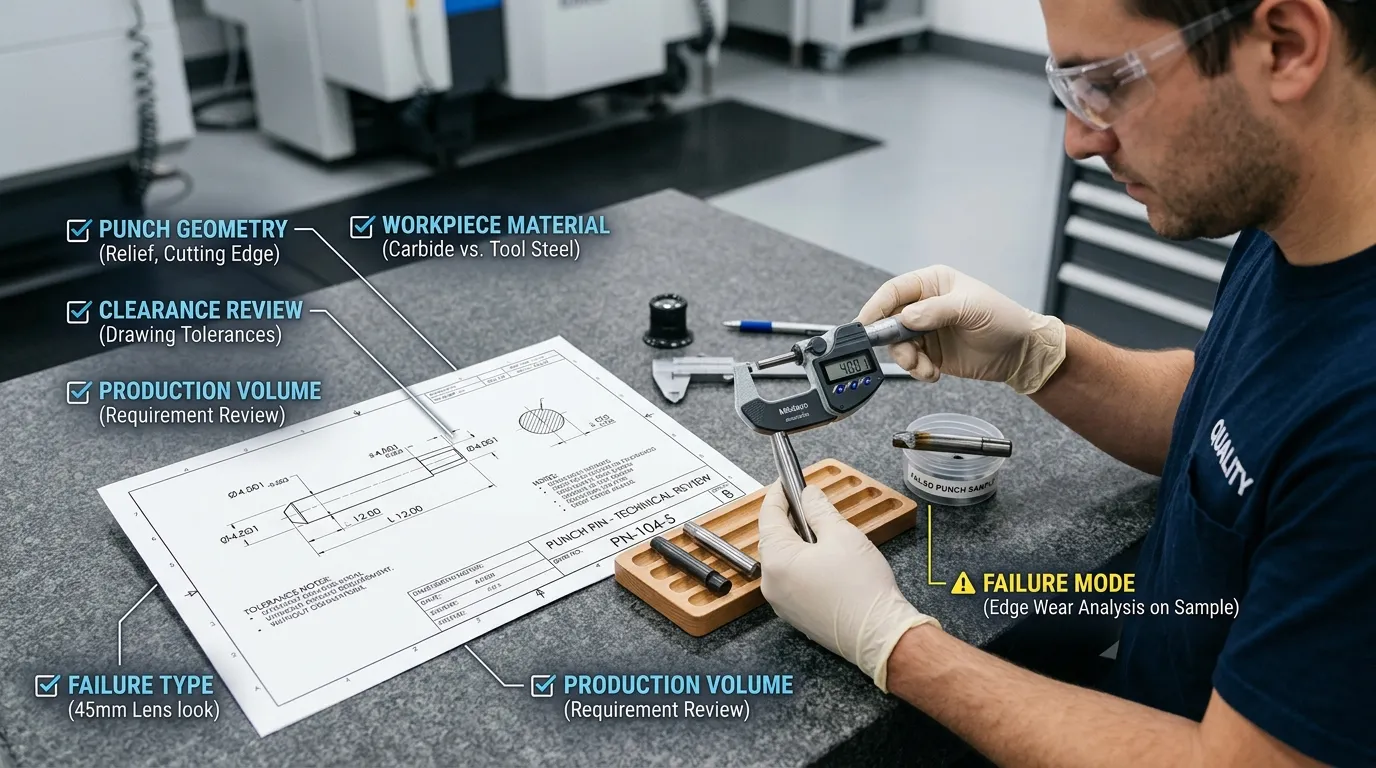
A supplier cannot make a defensible carbide-versus-tool-steel recommendation from the punch diameter alone.
Dostarczaj:
- Wymiarowany rysunek dziurkowany lub próbka fizyczna
- Punch diameter, Długość, Styl głowy, and transition geometry
- Wymagane tolerancje i wymagania dotyczące powierzchni
- Materiał i naniesienie elementu obrabianego
- Grubość i wytrzymałość obrabianego elementu
- Powłoka powierzchniowa lub powłoka
- Typ prasy i prędkość pracy, tam, gdzie to istotne
- Prześwit od dziurka do wydruku
- Warunki smarowania
- Układ strippera
- Oczekiwany roczny lub partiowy wolumen
- Obecny materiał dziurkarki i obróbka cieplna
- Obecny interwał eksploatacji
- Historia ponownego szlifowania
- Zdjęcia zużytych lub połamanych ciosów
- Opis trybu awarii
- Dopuszczalne granice zadziornia i wymiarów
- Przestoj lub wpływ na przestój
SunshinePro lists carbide punches, die punch pins, and high-speed steel punches within its Zakres matryc i kołków do dziurkowania. Its carbide punch information also lists grinding, EDM, Obróbka precyzyjna, wymiary niestandardowe, oraz wybrane opcje powłoki. The exact material grade, Geometria, tolerancja, Powłoka, and process route still need confirmation against the drawing and application.
Final Decision Rule: Match the Material to the Failure Mode
Choose carbide when controlled alignment and stable geometry allow wear resistance to reduce service interruptions and cost per accepted part. Choose tool steel when toughness, repairability, Geometria, or fracture control matters more than maximum wear resistance. Consider HSS or PM tool steel when the application falls between those positions.
The most reliable decision starts with the failed punch, the die condition, and the production data—not with hardness alone. To evaluate a custom requirement, Wyślij rysunek punch, Szczegóły elementów obrabianych, Warunki eksploatacji, and failure history through SunshinePro’s Strona kontaktowa.
Udostępnij:



Napisane przez Sunshine
W Sunshine, Jesteśmy profesjonalnym producentem i dostawcą komponentów do precyzyjnych form, oferując szeroką gamę produktów do tłoczenia i formowania wtryskowego. Naszym głównym celem są formy do dziurkania, Sworznie wyrzutowe i tuleje, oraz słupy i tuleje. Dzięki zaawansowanej obróbki CNC, Ścisła kontrola jakości, oraz silne możliwości produkcyjne, Zapewniamy niezawodność, Części o wysokiej precyzji, wraz ze standardowymi komponentami dostępnymi na stanie, zapewniającymi szybkie i efektywne globalne dostawy.
WIADOMOŚCI
UZYSKAJ USŁUGĘ
Z wysokiej jakości częściami dostosowanymi do każdego budżetu oraz przyjaznym personelem przeszkolonym, by Twoja wizyta była poinformowana i bezproblemowa.
