



Przewodnik po formach wtryskowych: Komponenty, Rodzaje, oraz Jak to działa
Injection mold systems are precision tools used to shape molten plastic into repeatable production parts. A typical injection mold includes cavities, Kolory, Kanały chłodzące, Biegacze, and ejector systems that control part quality, Czas cyklu, oraz trwałość. Understanding mold components, mold types, Czasy realizacji, and maintenance requirements helps manufacturers reduce defects, Poprawa spójności, and make better tooling decisions.
Forma wtryskowa wpływa na znacznie więcej niż tylko kształt części. Wpływa to na tempo produkcji, Dokładność wymiarowa, maintenance costs, and long-term manufacturing stability. A well-built mold can run for years with consistent output, while a poorly designed one can create delays, Wady, and expensive downtime. Ten przewodnik wyjaśnia, jak działają formy wtryskowe, which components matter most, and what buyers should understand before starting a tooling project.
Czym jest forma wtryskowa?
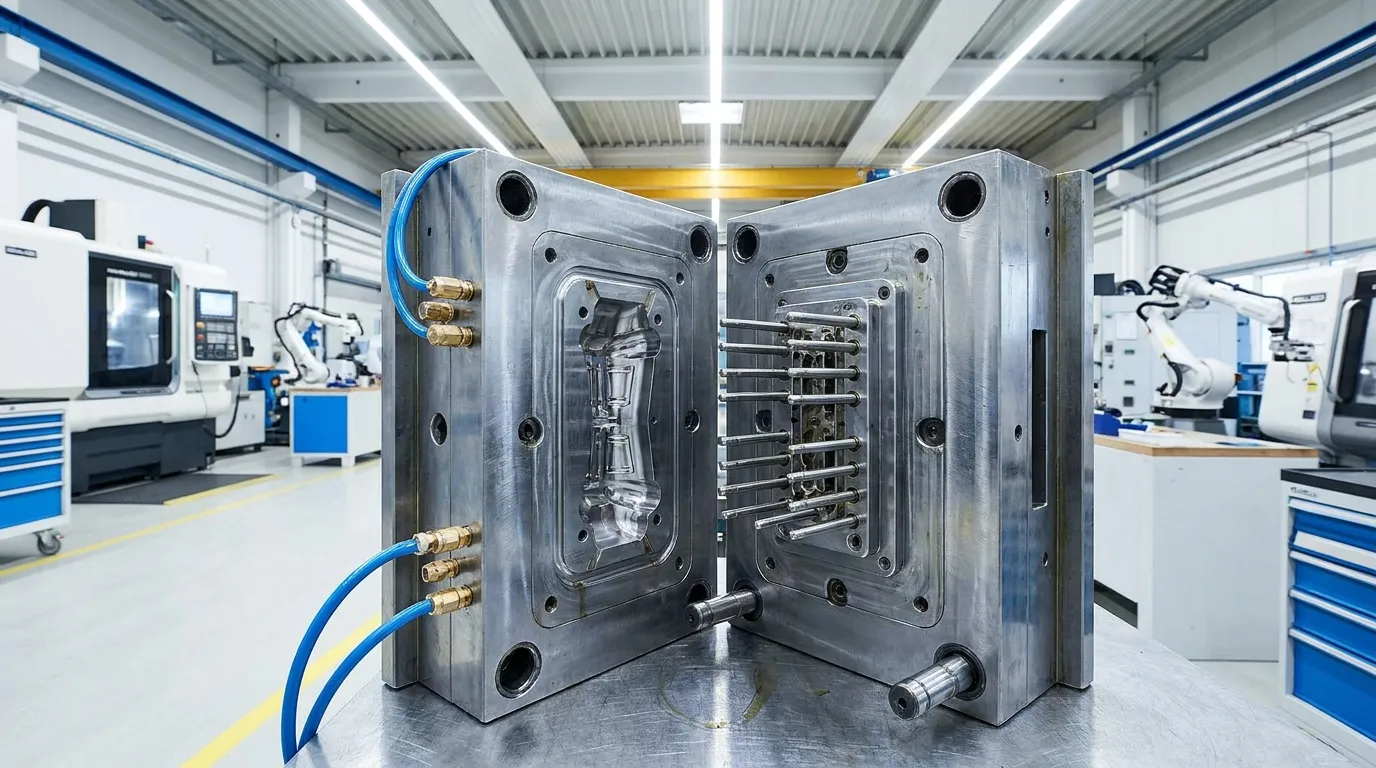
An injection mold is a precision tool used to shape molten plastic into finished parts during the injection molding process. It contains cavities, Kolory, Kanały chłodzące, and ejection systems that control part shape, Jakość powierzchni, oraz spójność produkcji.
An injection mold works like a reusable forming system. Molten plastic enters the mold under pressure, fills a cavity shaped like the final part, cools into a solid form, and then gets ejected so the cycle can repeat.
Most molds consist of two primary halves: the core side and the cavity side. When the mold closes, these sections align tightly to create the exact geometry of the plastic component. Small alignment errors can cause flashing, Wariacja wymiarowa, lub przedwczesne zużycie.
The mold itself often represents one of the largest investments in a plastic manufacturing project. That’s why manufacturers focus heavily on tooling precision, cooling efficiency, and material durability. Według Protolabs, mold design decisions directly affect manufacturability, Czas cyklu, and part quality.
For a broader explanation of the full molding workflow, Zobacz to Przewodnik po formowaniu wtryskowym tworzyw sztucznych.
How does an injection mold work step by step?
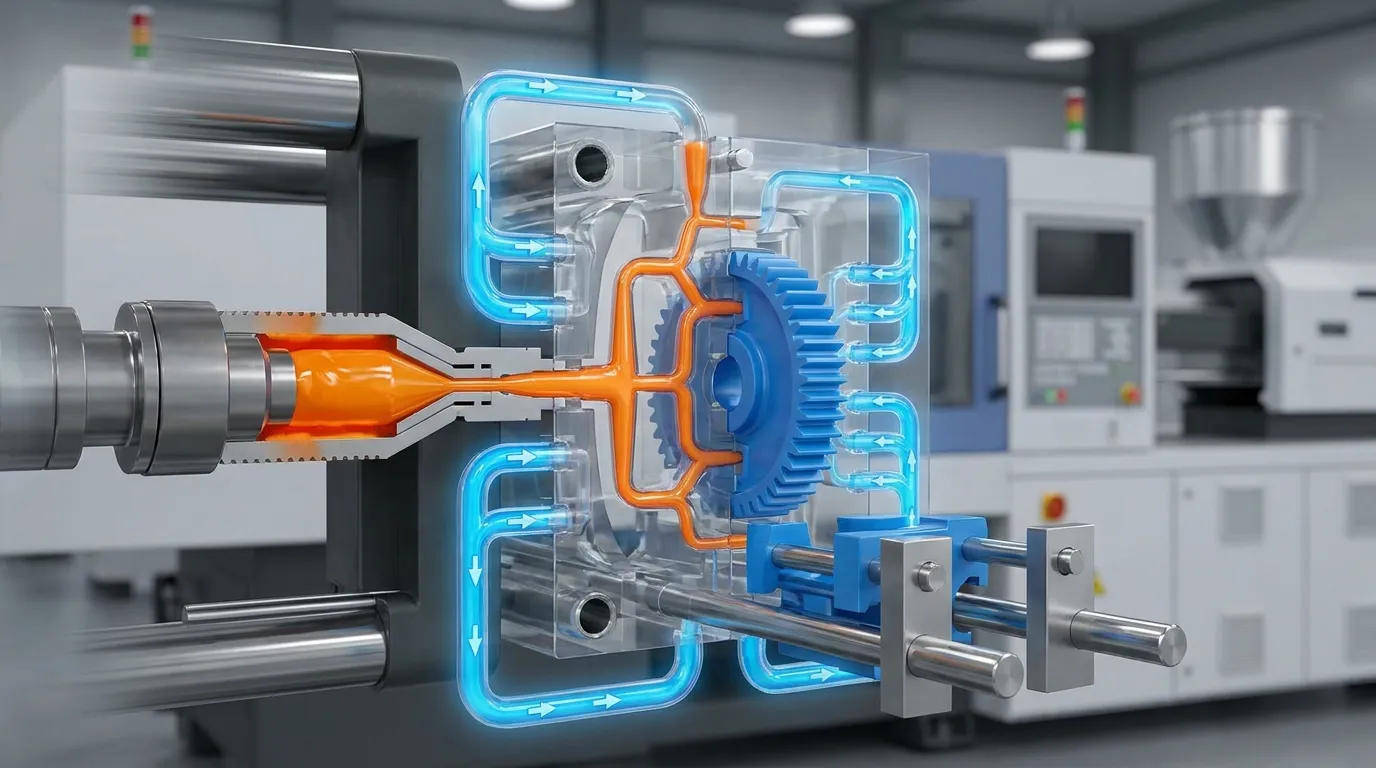
An injection mold works by receiving molten plastic under pressure, shaping the material inside a cavity, cooling it into a solid form, and ejecting the finished part before the cycle repeats. Every stage affects part quality and cycle time.
The process starts when plastic pellets melt inside an injection molding machine. The machine then injects the molten material into the mold cavity at controlled pressure and speed. Once the cavity fills completely, the cooling phase begins.
Etap wtrysku
Podczas wstrzykiwania, material flows through the sprue, System biegaczy, and gate before entering the cavity. Proper flow balance matters because uneven filling can create short shots, ślady zapadnięcia, or air traps.
A consumer electronics supplier producing 100,000 units per year may use a multi-cavity mold to improve throughput. W takim przypadku, balanced filling becomes even more important because uneven pressure distribution can create part variation between cavities.
Chłodzenie i zastygnięcie
Cooling channels inside the mold remove heat from the plastic. This stage often controls most of the production cycle time. Poor cooling design increases cycle times and raises the risk of warping or shrinkage problems.
A cooling imbalance can become expensive quickly. If one side of the mold cools slower than the other, operators may need to increase cycle time just to maintain acceptable dimensions. That reduces output and increases production cost per part.
Według Asahi Kasei, cooling efficiency and material flow behavior strongly affect molding stability and dimensional control.
Wyrzucenie części
After the part solidifies, the mold opens and the ejection system pushes the part out safely. Sworznie wyrzutowe, Rękawy, and lifters prevent parts from sticking inside the cavity.
This stage sounds simple, but it creates many production problems. Poor ejection force or worn components can leave marks, crack delicate parts, or slow production cycles.
For examples of industry use cases, Zobacz te Zastosowania w formach wtryskowych.
Jakie są główne elementy formy wtryskowej?
The main components of an injection mold include the core, Ubytek, System biegaczy, Kanały chłodzące, System wyrzutnika, and alignment components. Razem, these parts control material flow, Dokładność wymiarowa, cooling efficiency, and safe part removal.
Every mold component affects part quality differently. Some control geometry, while others manage alignment, Chłodzenie, or cycle efficiency. Problems in one area often create defects somewhere else in the process.
| Składnik | Główna funkcja | Wpływ na produkcję |
|---|---|---|
| Rdzeń | Geometria wewnętrznych elementów formuje | Kontroluje dokładność wymiarową |
| Ubytek | Kształt części zewnętrznej | Wpływ na wykończenie powierzchni |
| System biegaczy | Kieruje przepływem stopionego plastiku | Oddziaływanie wypełnia spójność |
| Brama | Kontroluje wejście do wnęki | Wpływ na jakość kosmetyczną |
| Kanały chłodzące | Usuń ciepło | Czas cyklu sterowania |
| System wyrzutu | Usuwa gotowe części | Zapobiega przyklejaniu się i uszkodzeniom |
| Sworznie prowadzące i tuleje | Utrzymanie wyrównania | Zmniejsza zużycie i błyski |
System chłodzenia
Cooling channels regulate mold temperature during production. Efficient cooling reduces cycle time and improves dimensional stability.
Medical device molds often require tighter thermal control because small dimensional shifts can affect product fit and validation requirements. In these projects, cooling design directly affects both quality and lead time.
System wyrzutu
The ejection system pushes finished parts out of the mold after cooling. Sworznie wyrzutowe, Rękawy, and stripper plates must apply force evenly to avoid damaging the part.
Worn ejector components create visible production problems. Parts may stick, eject unevenly, or develop stress marks during removal.
For a deeper look at component systems, Zobacz to Przegląd komponentów form.
Why are guide pins, tulejki, and core pins critical?
Sworznie prowadzące, tulejki, and core pins maintain alignment and dimensional consistency inside injection molds. Poor alignment increases wear, flash defects, part variation, and maintenance frequency during high-volume production.
Alignment components are easy to overlook because they operate in the background of the molding cycle. Mimo to, they directly affect mold lifespan and production consistency. Even small alignment shifts can create uneven cavity pressure and accelerated wear.
Guide pins and bushings help the mold halves close accurately every cycle. Without stable alignment, the mold may develop flashing around part edges or uneven surface finishes. High-volume automotive projects often experience these issues first because repeated cycling increases wear over time.
Core pins form internal holes, Sloty, and detailed features inside molded parts. These components must maintain tight tolerances under heat and pressure. A worn core pin can change hole dimensions enough to create assembly problems downstream.
A high-volume automotive trim supplier, na przykład, may experience flashing defects after guide components wear unevenly. Replacing those alignment parts early often costs far less than running unstable production for weeks.
Dowiedz się więcej o Sworznie prowadzące formę and how they support mold alignment accuracy.
What types of injection molds are commonly used?
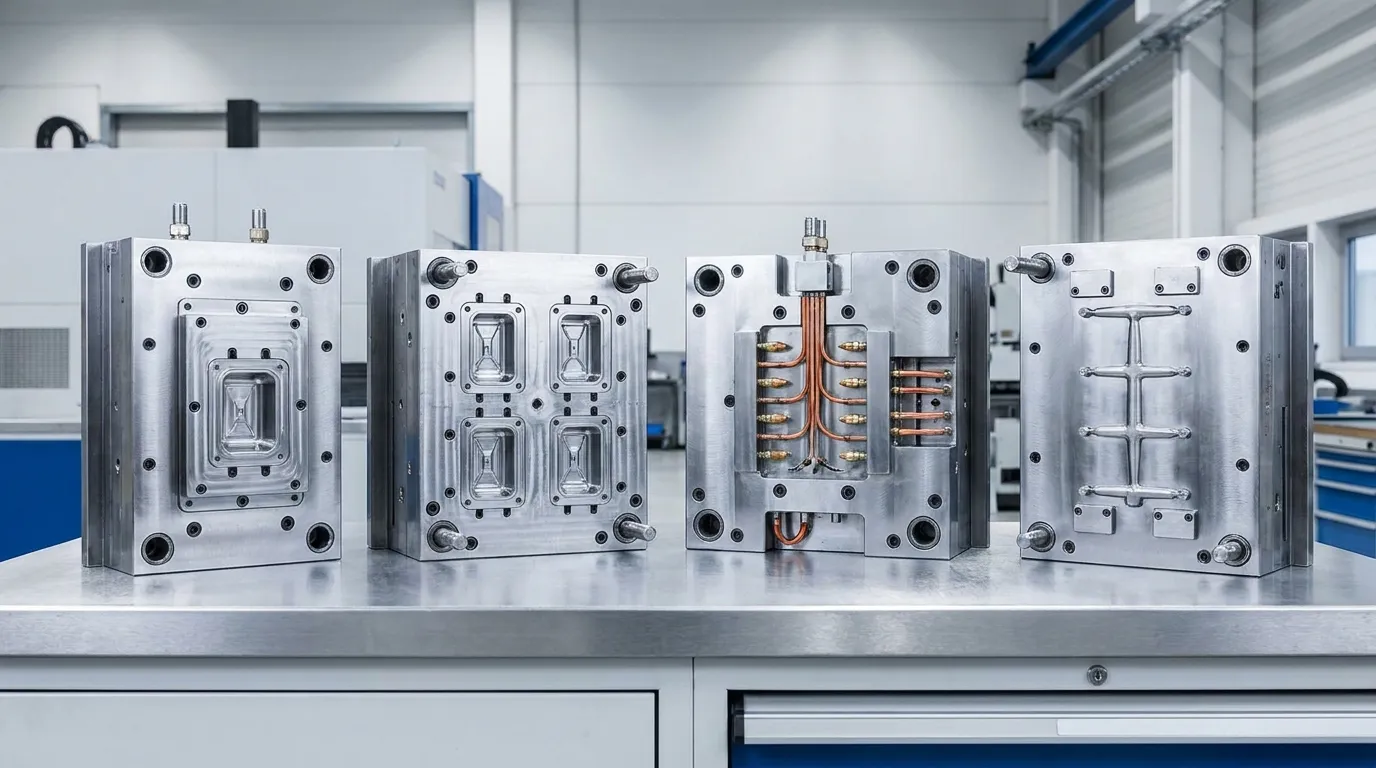
Different injection mold types support different production goals. Single-cavity molds prioritize precision and lower upfront complexity, while multi-cavity and hot-runner molds improve production speed and efficiency for higher-volume manufacturing.
No single mold type works best for every project. Wielkość produkcji, Geometria części, budget, and lead-time goals all influence the right tooling choice.
| Typ formy | Najlepszy przypadek użycia | Główna zaleta | Główne ograniczenie |
|---|---|---|---|
| Forma z jedną komorą | Niskie do średniej objętości | Łatwiejsza kontrola procesów | Niższa produkcja |
| Forma wielokomorowa | Produkcja wielkomasowa | Wyższa przepustowość | Większa złożoność równowagi |
| Pleśń rodzinna | Powiązane zestawy części | Wytwarza wiele części razem | Trudniej jest równomiernie zoptymalizować |
| Forma gorącego kanału | Duże serie produkcyjne | Mniej marnotrawstwa materiałowego | Wyższy koszt narzędzi |
| Forma do zimnego kanału | Prostsze projekty | Niższy koszt początkowy | Więcej materiałów złomu |
Formy stalowe vs aluminiowe
Steel molds are usually the better choice for long production runs. They handle wear more effectively and maintain tighter tolerances over time. Aluminum molds reduce upfront tooling cost and shorten machining time, which makes them useful for prototyping or smaller production runs.
Aluminum molds are not always the cheapest long-term option. They work well for limited production, but hardened steel molds often become more economical when annual volumes rise significantly.
Multi-cavity molds are not automatically better either. They improve output, but they also increase balancing complexity and maintenance requirements. A poorly balanced multi-cavity system can create inconsistent parts across different cavities.
What affects injection mold cost and lead time?
Injection mold cost and lead time depend on mold complexity, Liczba ubytków, Materiały narzędziowe, Wymagania tolerancyjne, and revision cycles. Production molds commonly require several weeks of machining, Testowanie, Walidacja, and adjustment before full-scale manufacturing begins.
Tooling cost varies widely because every mold project has different technical requirements. A simple prototype mold may move quickly, while a production mold with tight tolerances and multiple cavities can require extended machining and validation work.
Several factors affect both pricing and schedules:
- Złożoność części
- Liczba ubytków
- Wymagania dotyczące wykończenia powierzchni
- Złożoność systemu chłodzenia
- Wybór stali formowej
- Tolerancje wymiarowe
- Cykle próbkowania i walidacji
Dlaczego harmonogramy opóźnień w modyfikacjach narzędzi
Late design changes often create the biggest delays. Gdy rozpoczęto cięcie stali, even small geometry revisions may require re-machining, welding, or insert replacement.
A medical housing project, na przykład, may require additional validation after tolerance changes during development. That extra testing can extend tooling timelines significantly.
Fast mold delivery is not always a competitive advantage. Rushed tooling projects can increase revision cycles and create long-term production instability if validation gets compressed too aggressively.
| Czynnik Projektu | Wpływ na koszty | Wpływ na czas realizacji |
|---|---|---|
| Konstrukcja wielokomorowa | Wysoko | Umiarkowany |
| Ścisłe tolerancje | Wysoko | Wysoko |
| Hartowana stal | Umiarkowany | Umiarkowany |
| Chłodzenie złożone | Umiarkowany | Wysoko |
| Późne zmiany w projekcie | Wysoko | Wysoko |
Według Aprios, tooling validation and revision cycles are major contributors to injection mold lead times.
For more detail on precision tooling features, Zobacz Sworznie rdzeniowe w formowaniu wtryskowym.
What problems commonly affect injection molds?
Common injection mold problems include flash, krótkie ujęcia, Elementy przyklejające się, uneven cooling, and ejector wear. Many issues are caused by poor maintenance, weak venting, Niedopasowanie, or process instability during repeated production cycles.
Most mold problems develop gradually. Small alignment issues, clogged cooling channels, or worn ejector systems often become visible only after repeated production cycles.
| Problem | Przyczyna wspólna | Wpływ na produkcję |
|---|---|---|
| Flash | Nieułożenie formy | Nadmiar materiału wokół krawędzi |
| Krótkie ujęcie | Niepełne wypełnienie | Brakująca geometria |
| Odkształcenie | Nierównomierne chłodzenie | Zniekształcenie wymiarowe |
| Elementy przyklejające się | Słabe wyrzucenie | Opóźnienia cykliczne |
| Znaki przepływu | Niestabilny przepływ materiału | Wady kosmetyczne |
Cooling imbalance is one of the most expensive hidden problems in production. If operators increase cooling time to compensate for inconsistent temperatures, overall output drops even when the parts still pass inspection.
Maintenance schedules matter here. Replacing worn alignment components early can prevent larger tooling failures later. Many production teams focus on machine settings first, even though worn mold components may be the real cause of instability.
Według Elastron, defects often result from unstable processing conditions combined with tooling or cooling issues.
Dodatkowe informacje o komponentach wrażliwych na zużycie dostępne są w tym przewodniku do Sworznie i tuleje formowe.
How long does an injection mold last?
Injection mold lifespan depends on tooling material, Produkcja, Typ żywicy, and maintenance quality. A properly maintained steel mold can support very high production cycles before major refurbishment becomes necessary.
Steel molds generally last much longer than aluminum molds because they resist wear more effectively under repeated heat and pressure cycles. Production molds used in automotive or consumer electronics manufacturing may operate continuously for years with scheduled maintenance intervals.
Maintenance has a major effect on lifespan. Cooling channels need regular cleaning, moving components require lubrication, and alignment systems should be inspected for wear. Ignoring those tasks increases the chance of flashing, Elementy przyklejające się, lub dryf wymiarowy.
Here are common factors that affect mold longevity:
- Ścierność żywicy
- Wielkość produkcji
- Sprawność chłodzenia
- Częstotliwość konserwacji
- Twardość stali formowej
- Stabilność wyrównania
Według ESCATEC, tooling maintenance and operating conditions strongly influence mold service life.
For examples of wear-sensitive tooling features, Przejrzyj te recenzje Precyzyjne sworznie rdzeniowe.
What should buyers ask before ordering an injection mold?
Choosing the right mold supplier requires more than comparing price quotes. Buyers should understand how the supplier handles tooling validation, maintenance support, and production consistency before approving a project.
A clear supplier discussion early in the process can prevent expensive revisions later. That matters especially for production molds with tight tolerances or multi-cavity designs.
Lista kontrolna dla kupujących formę wtryskową
| Pytanie | Dlaczego to ważne |
|---|---|
| What mold steel will be used? | Wpływa na trwałość i odporność na zużycie |
| How will tolerances be validated? | Potwierdza dokładność wymiarową |
| What is included in sampling? | Zapobiega zamieszaniu związanemu z zatwierdzeniem |
| How are design revisions handled? | Zmniejsza ryzyko opóźnień |
| What maintenance support is available? | Poprawia długoterminową niezawodność |
| Can the supplier support export logistics? | Pomaga uniknąć opóźnień w dostawach |
| What machine size will run the mold? | Zapewnia kompatybilność produkcyjną |
A production tooling project becomes much easier when both sides define expectations early. Buyers who ask detailed questions about validation, Konserwacja, and revision handling usually face fewer production surprises later.
Poprawne wykonanie kolejnego kroku
An injection mold affects production quality long before the first molded part leaves the machine. The right tooling design improves consistency, Czas cyklu, and long-term manufacturing stability. The wrong approach can create years of avoidable maintenance and quality problems.
If you're reviewing a new tooling project, focus on the full production picture instead of only the initial mold price. Cooling design, alignment systems, Wybór materiałów, and validation planning all affect long-term results. Understanding how these systems work together makes it easier to choose the right mold strategy for your production goals.
Najczęściej zadawane pytania
What is the purpose of an injection mold?
An injection mold shapes molten plastic into finished parts with repeatable dimensions and surface quality. It controls cooling, Przepływ materiałów, and part ejection during high-volume manufacturing.
Jak długo trwa zbudowanie formy wtryskowej?
Injection mold lead times often range from several weeks to several months depending on complexity, Liczba ubytków, Wymagania testowe, oraz zmiany w narzędziach. Production-grade molds usually require machining, Próbkowanie, and validation before release.
Dlaczego formy wtryskowe są drogie?
Formy wtryskowe wymagają precyzyjnej obróbki, hardened tooling materials, engineering validation, and detailed finishing work. Complex molds with tight tolerances or multiple cavities increase both manufacturing time and tooling cost.
What materials are injection molds made from?
Most injection molds are made from hardened steel or aluminum depending on production volume and durability requirements. Steel molds generally support longer production runs and stronger wear resistance.
What causes injection molding defects?
Injection molding defects can result from poor cooling, uwięzione powietrze, worn mold components, unstable pressure, or incorrect process settings. Proper mold maintenance and stable processing conditions reduce defect frequency.
How long does an injection mold last?
Injection mold lifespan depends on tooling material, Produkcja, Jakość utrzymania, and resin type. Properly maintained steel molds can support very high production cycles before major refurbishment becomes necessary.
Udostępnij:



Napisane przez Sunshine
W Sunshine, Jesteśmy profesjonalnym producentem i dostawcą komponentów do precyzyjnych form, oferując szeroką gamę produktów do tłoczenia i formowania wtryskowego. Naszym głównym celem są formy do dziurkania, Sworznie wyrzutowe i tuleje, oraz słupy i tuleje. Dzięki zaawansowanej obróbki CNC, Ścisła kontrola jakości, oraz silne możliwości produkcyjne, Zapewniamy niezawodność, Części o wysokiej precyzji, wraz ze standardowymi komponentami dostępnymi na stanie, zapewniającymi szybkie i efektywne globalne dostawy.
WIADOMOŚCI
UZYSKAJ USŁUGĘ
Z wysokiej jakości częściami dostosowanymi do każdego budżetu oraz przyjaznym personelem przeszkolonym, by Twoja wizyta była poinformowana i bezproblemowa.
