



Przyczyny uszkodzenia klinu limitującego formę: Zginanie, Zużycie, oraz Uszkodzenia Uderzeniowe
Mold limit pin failure usually points to more than a damaged pin. Bending often indicates side loading, Niedopasowanie, binding, poor support, or loose mounting. Scoring and diameter loss can reveal contamination, incorrect fit, or damaging sliding contact. Grzyby, indentation, and cracking commonly indicate repeated hard impact, incorrect contact timing, or unequal loading.
A limit pin works as part of a larger mechanical system. Its bore, mounting seat, mating stop surface, surrounding plates, and other Standardowe części formy (wnioskowane) can all influence how force reaches the pin. Replacing the visibly damaged component without inspecting that system may cause the new pin to fail in the same position.
The correct troubleshooting sequence is:
- Identify the visible failure mode.
- Determine the mechanical condition that could produce it.
- Inspect the pin and surrounding components.
- Confirm the cause with measurements and operating evidence.
- Correct the cause before installing a replacement.
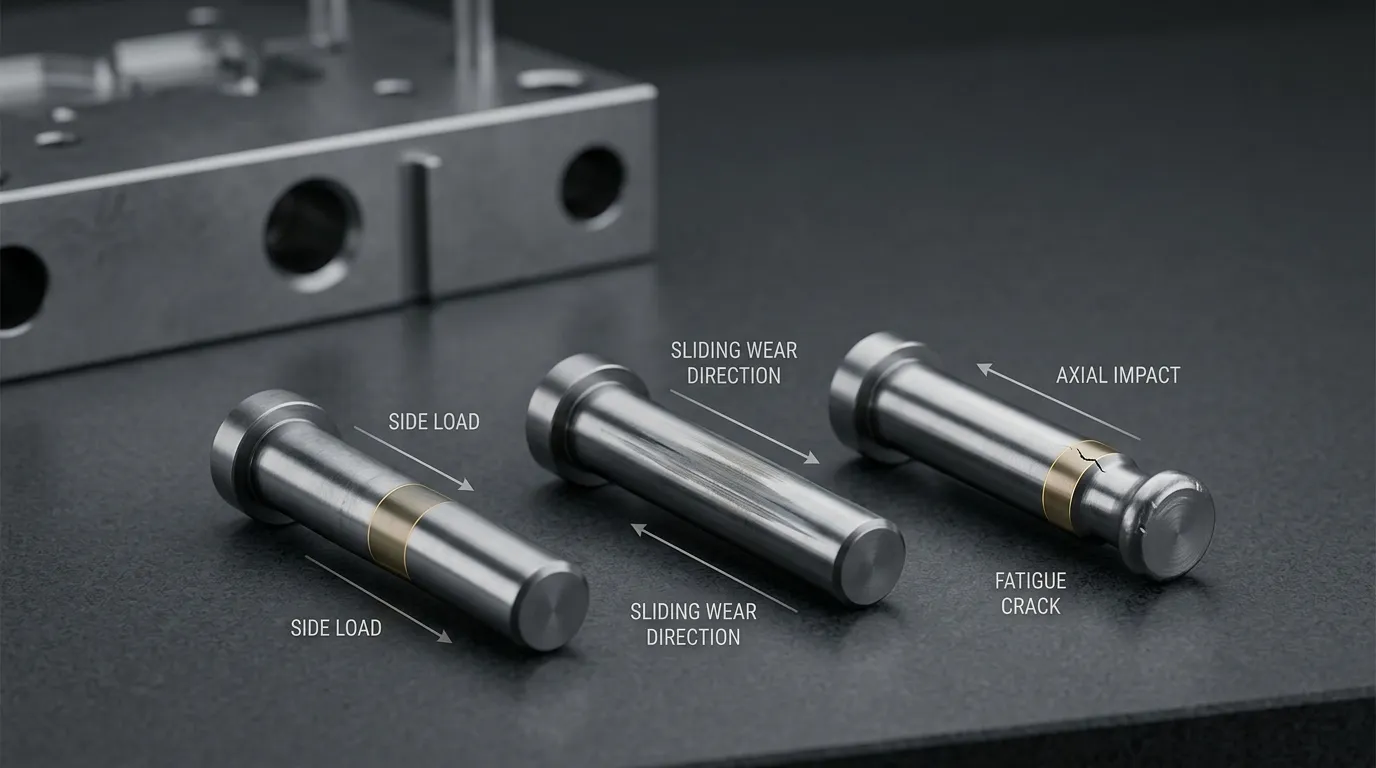
Co wzór uszkodzeń może Ci powiedzieć
Physical damage provides useful clues, but one mark rarely proves a root cause by itself. Treat each observation as a starting point for inspection.
| Zaobserwowane uszkodzenia | Prawdopodobny mechanizm | Warunki do inspekcji | Potwierdzam sprawdzenie |
|---|---|---|---|
| Sworzeń wygięty w jednym kierunku | Obciążenie boczne lub kompresja ekscentryczna | Mold alignment, Pozycja cylindra, binding, contact location, mounting condition | Porównaj kierunek zgięcia ze śladami zużycia i wzorem kontaktu |
| Trzon zakrzywiony lub wygięty bez silnego zużycia bocznych | Niestabilność kompresyjna lub wyboczenie | Długość bez podparcia, Średnica sworzni, support condition, obstruction, przeciążenie | Sprawdź prostość, support points, and installed geometry |
| Jednostronna, polerowana opaska | Powtarzający się kontakt boczny | Niedopasowanie, tilted installation, damaged bore, nonparallel movement | Zmierz zużycie wokół obwodu i sprawdź otwor |
| Głębokie rysy podłużne | Zużycie ścierne | Szczątki, rough bore, damaged mating surface, inadequate cleaning | Sprawdź kierunek rowka i szukaj cząstek lub wypukłych powierzchni |
| Materiał rozmazany lub przeniesiony | Zużycie lub uszkodzenie adhezji | Ciasne dopasowanie, binding, sliding under load, Warunki smarowania | Sprawdź podchwyt materiału na obu stykających się powierzchniach |
| Spłaszczony lub grzybkowity koniec | Powtarzające się uderzenia i odkształcenia plastyczne | Stroke, contact timing, stop-face condition, installed height | Porównaj wszystkie odpowiadające sobie piny i sprawdź przeciwległy stop |
| Wcięcie poza centrem | Wpływ ekscentryczny | Unequal contact, tilted pin, nonparallel plate, damaged stop surface | Sprawdź ślady świadków i pozycję kontaktu |
| Crack near a thread, Ramię, or surface defect | Naprężenie cykliczne przy stężeniu naprężeń | Repeated bending, Wpływ, abrupt geometry, machining damage | Zachowaj powierzchnię pęknięcia i zbadaj źródło pęknięcia |
| To samo położenie sworzni powtarza się wielokrotnie | Problem nieskorygowanego systemu lokalnego | Bore, Siedziba, stop face, plate alignment, load sharing, thermal movement | Porównaj tę pozycję z sąsiednimi przypinkami i historią produkcji |
Terminologia standaryzowanego zużycia jest zdefiniowana w ASTM G40. W praktyce, the most important distinction is whether material was removed by particles or rough contact, transferred through adhesive sliding, or deformed by direct impact.
Dlaczego kołki limitujące formę się wyginają lub wyginają
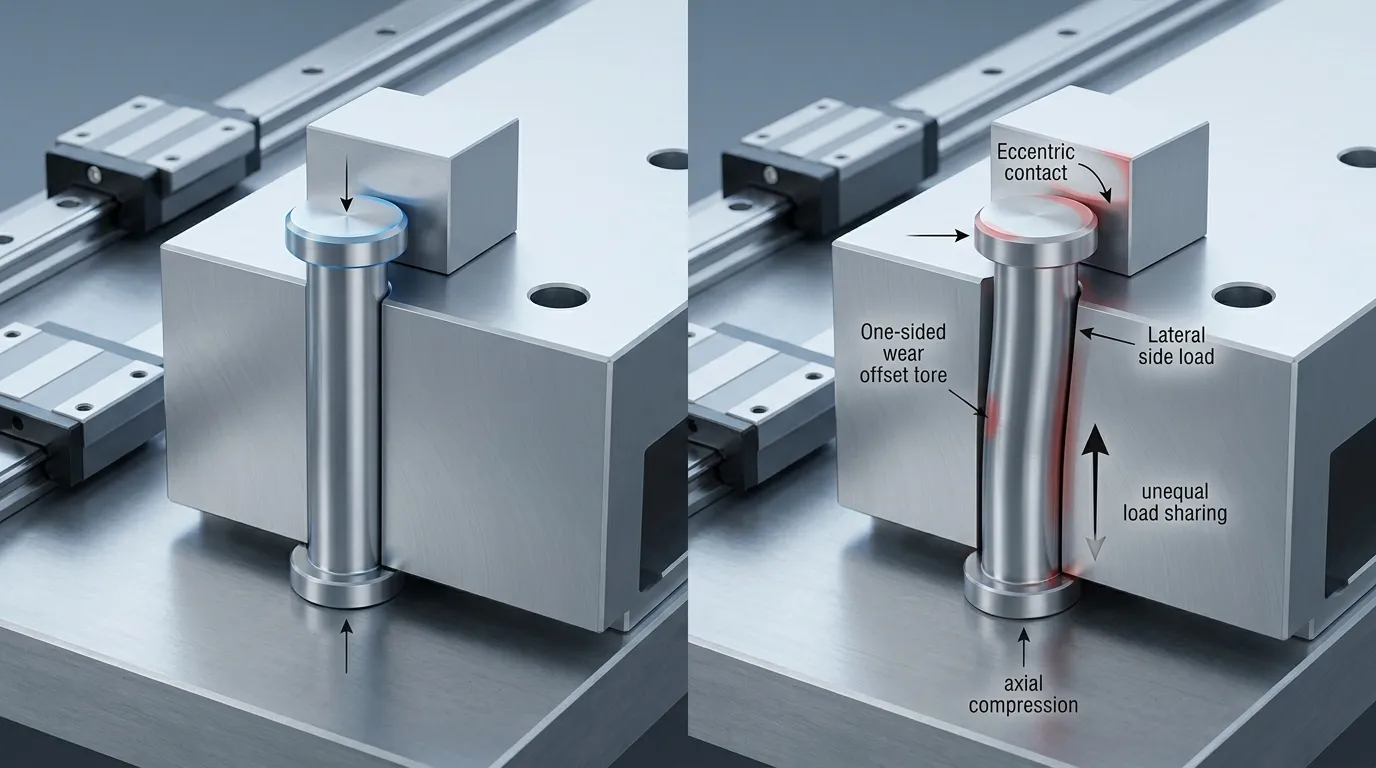
A limit pin normally performs best when force acts close to its centreline. Once contact becomes eccentric, part of the load acts sideways. That lateral component creates bending stress, even when the total machine load has not changed.
Common bending causes include:
- Otwor sworzni, który jest przesunięty lub już nie jest prosty
- Ruch nierównoległy między płytami formowymi
- Sworzeń stykający się z powierzchnią stopu od jej środka
- Związanie podczas części pociągnięcia formy
- A loose thread, Aparat retainerowy, or mounting seat
- Niewystarczające wsparcie wzdłuż odsłoniętej długości sworzni
- Przeszkoda, która wymusza przesunięcie płytki lub sworzni na bok
- Jeden pin styka się wcześniej niż inne piny graniczne
A harder replacement pin does not correct any of these conditions. It may resist some surface wear, but the lateral load will remain.
Niedopasowanie, Binding, and Eccentric Contact
Misalignment changes an intended axial stop into a bending load. The first evidence is often a one-sided wear band, an off-centre mark on the contact face, or a bend that points away from the loaded side.
Inspect the complete movement path:
- Does the pin enter or pass through its bore without side contact?
- Is the bore worn more heavily on one side?
- Do the plates remain parallel through the full stroke?
- Does the pin begin binding only after the mold heats up?
- Do all corresponding limit pins touch at the same time?
- Is the mating stop surface flat and correctly positioned?
Broader problems involving guided movement, Dopasowanie, and alignment may also involve Sworznie i tuleje formowe. Those components should be inspected when the limit pin’s bending direction matches wider guide-system wear.
Unsupported Length, Przeciążenie, and Loose Mounting
A long exposed section is more vulnerable to lateral deflection and compression instability. Under sufficient axial load, a slender or poorly supported pin may bow rather than remain straight. This is different from a pin that bends because its contact point is visibly off-centre, although both conditions can occur together.
Mounting problems can reduce effective support. A pin that is not fully seated may project farther than intended. A loose thread or damaged retainer may allow movement at the base. A distorted mounting seat can tilt the entire pin before it reaches the stop surface.
Check the installed condition against the approved drawing rather than assuming the failed pin had the correct projection, Zaangażowanie, or support.
Why Limit Pins Wear, Ścieżka dźwiękowa, or Gall
Not all polished surfaces indicate harmful wear. Światło, even contact may simply show where the pin is working. Concern increases when material loss is concentrated on one side, deep grooves appear, the diameter changes measurably, or metal transfers between surfaces.
The location and direction of wear matter:
| Wzorzec zużycia | Prawdopodobna przyczyna | Co zweryfikować |
| Nawet polerowanie obwodu | Kontakt normalny lub rozproszony | Straty średnicy i granice pociągania |
| Polerowanie jednostronne | Niewyrównanie lub obciążenie boczne | Bore position, plate movement, pin straightness |
| Długie, proste rowki | Cząstki ścierne lub grube cylindry | Zanieczyszczenie, burrs, damaged counterpart |
| Rozdarta lub rozmazana powierzchnia | Zużycie lub uszkodzenie adhezji | Dopasowanie, sliding load, Ciepło, Smarowanie |
| Lokalne zużycie w pobliżu końca montażowego | Luźne podparcie lub ruch siedzenia | Thread, Aparat retainerowy, Otwor, seating condition |
| Zużycie widoczne tylko podczas produkcji | Zmiana termiczna w przeświecie lub ustawieniu | Wymiary i ruch gorące kontra zimno |
Measure the diameter at several positions along the shank and in more than one direction. One measurement near an unworn area can hide localized material loss.
Ścierne zużycie spowodowane zanieczyszczeniami lub szorstkim kontaktem
Abrasive wear occurs when hard particles or raised surface defects cut or plough the pin. Typical evidence includes directional grooves, fine metallic debris, or a rough track that follows the direction of movement.
Możliwe źródła to:
- Zanieczyszczenie wewnątrz otworu sworzni
- Zadziorny lub wypukłe krawędzie po konserwacji
- Uszkodzenia powierzchni odbiorczej
- Produkty korozji lub utwardzone osady
- Zużycie zanieczyszczone między ruchomymi powierzchniami
Replacing the pin without removing the abrasive source will usually reproduce the same scoring. Clean the movement path, inspect the bore under suitable lighting, and check for raised material rather than looking only for visible dirt.
Zużycie kleju, Galling, and Binding
Adhesive wear develops when loaded surfaces slide against each other and local contact causes material to transfer or tear. Severe adhesive wear is often described as galling. The surface may appear smeared, rough, picked up, or partially seized rather than cleanly scratched.
Contributing conditions include:
- Niewystarczający prześwit roboczy
- Niewyrównanie wymuszające ciągły kontakt boczny
- Rozszerzalność cieplna, która zamyka dostępny odstęp
- Zły stan powierzchni
- Obciążenie ślizgowe bez odpowiedniego smarowania, gdy smarowanie jest wymagane
Tribology covers the interaction of surfaces in relative motion, including friction, Przyczepność, Smarowanie, and wear, as explained by the Narodowy Instytut Standardów i Technologii.
Lubrication can reduce friction in an appropriate sliding interface, but it cannot correct an off-centre stop, damaged bore, loose mounting, or excessive impact. Applying more lubricant without identifying the contact condition may hide the symptom temporarily while the mechanical cause remains.
Dlaczego powstają uszkodzenia uderzeniowe i pęknięcia zmęczeniowe
A limit pin that repeatedly strikes its mating surface can deform even when it does not break immediately. The contact face may flatten, mushroom at the edge, develop a local indentation, or begin cracking near a shoulder or thread.
Repeated hard contact may result from:
- Nieprawidłowy ruch lub przejście za duże
- Kontakt nastąpił wcześniej niż planowano
- Różne wysokości montażu pomiędzy poszczególnymi pinami
- Płytki nierównoległe
- Uszkodzona lub wgnieciona powierzchnia ogranicznika
- Szczątki na powierzchni styku
- Nadmierna prędkość w momencie kontaktu
- Jeden sworzeń niósł większy ładunek niż pozostałe
The impact mark should be near the intended contact area. A mark near one edge suggests eccentric loading and should prompt checks of pin position, plate movement, and the mating stop.
Powtarzający się twardy kontakt i nierówny podział obciążenia
Multiple limit pins do not automatically share load equally. A small difference in installed height, seat condition, plate alignment, or stop-surface position may cause one pin to contact first. That pin then absorbs the initial impact and may carry most of the load.
Compare all corresponding pins rather than inspecting only the failed one. Szukaj:
- Różne rozmiary znaków świadków
- Różne poziomy polerowania lub wgniecenia
- Jedna przypinka z grzybkowym końcem, podczas gdy inne pozostają lekko oznaczone
- Szczątki pod jednym z miejsc montażowych
- Zagłębiony lub uszkodzony ogranicznik godowy
- Różnice w projekcji pinów
Repeated failure at the same position strongly suggests a local contact or support problem, not random pin quality variation.
Pękanie zmęczeniowe po wielokrotnym zgięciu lub uderzeniu
Fatigue develops when cyclic stress initiates a small crack and causes it to grow over repeated load cycles. A pin may eventually fracture even though no single cycle appears severe enough to cause immediate breakage.
Cracks often begin where local stress is concentrated, takie jak:
- Korzenie nici
- Ostre ramię
- Nagłe przejście średnicowe
- Głęboka ścieżka
- Uszkodzona krawędź styku
- Wadę obróbki lub powierzchnię
ASTM E466 identifies material, Geometria, Stan powierzchni, Twardość, Zakończenie, Stres, and other variables that can affect fatigue-test results for metallic materials. The standard does not provide a universal service-life value for a mold limit pin.
Do not polish, grind, or discard a fractured pin before the crack origin has been reviewed. Surface alteration can remove evidence needed to distinguish progressive fatigue from final overload.
Jak zdiagnozować przyczynę przed wymianą sworzni
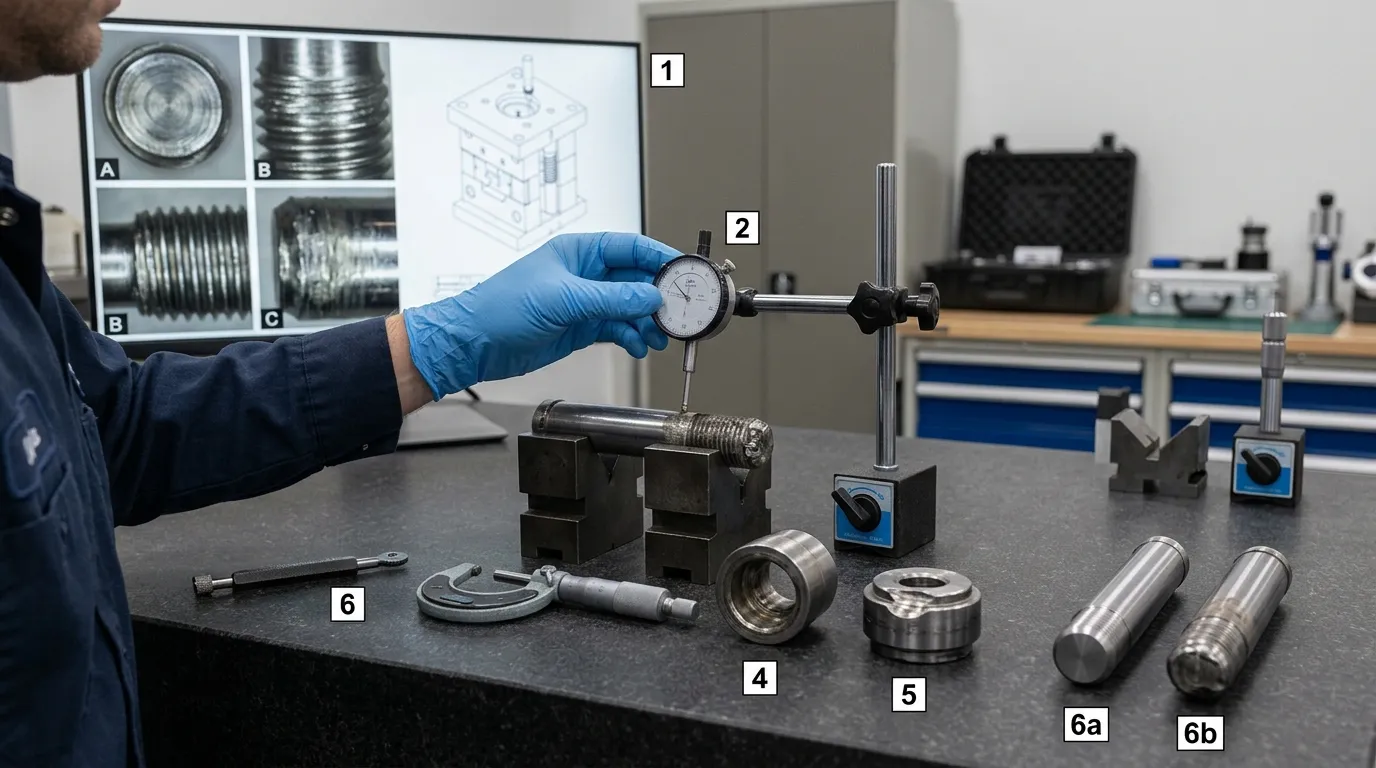
Before entering the mold area or beginning service work, isolate hazardous energy according to the rules that apply at the operating location. In the United States, Wytyczne OSHA dotyczące maszyn do formowania wtryskowego requires appropriate lockout and tagout during qualifying servicing work. Interlocks should not be treated as a substitute for proper energy isolation.
Use the following sequence after the equipment has been made safe:
- Record the pin’s installed position and orientation. Mark which side faced the observed wear, bend, or impact.
- Photograph the damage before cleaning. Capture the shank, contact face, mounting area, Otwor, stop surface, and neighbouring pins.
- Compare all corresponding pins. Differences in wear or impact marks can expose unequal contact timing.
- Check straightness or runout. Do not rely only on visual judgment.
- Measure diameter at several locations. Check more than one direction at each position to identify ovality or one-sided loss.
- Inspect the contact face and transitions. Look for peening, indentation, edge chipping, pęknięcia, and off-centre witness marks.
- Inspect the thread, Aparat retainerowy, Siedziba, and mounting bore. Confirm that the pin was fully seated and securely located.
- Inspect the receiving bore and mating stop. Szukaj punktów, raised material, indentation, Zanieczyszczenie, and unequal contact.
- Compare the findings with the approved drawing or unused part. Acceptance depends on the component’s actual specification, not a universal wear limit.
- Review the operating history. Note when the failure appeared, whether the mold had recently been serviced, and whether the problem changes after warm-up.
Zachowaj dowody przed czyszczeniem lub przerobieniem
Keep the failed pin in its original condition until the basic investigation is complete. Record:
- Forma i pozycja kołka
- Orientacja instalacji
- Data produkcji lub okres cyklu
- Ostatnie konserwacje lub zmiany komponentów
- Zdjęcia uszkodzeń
- Pomiary
- Wszelkie odłamki lub przeniesione materiały
- Obserwacje operacyjne gorąco kontra zimno
A fracture surface, wear track, or contact mark may contain more useful information than the final dimensional measurement.
Zmierz sworzeń i sprawdź cały układ styków
The pin should never be evaluated in isolation. A correct replacement installed into a damaged bore or against an indented stop face can fail quickly.
Failure-specific measurements may include:
- Straightness or runout
- Średnica wzdłuż długości roboczej
- Straty średnicy lokalnej
- Wypustka pinu lub wysokość montażu
- Stan gwintu lub retainera
- Stan siedziska
- Średnica cylindra i widoczne zużycie
- Pozycja styku na stopie zderzeniowym
- Względna wysokość sprzężków parowych
For broader guidance on tolerance, Stal, Zakończenie, and supplier inspection, patrz Części do precyzyjnych form. The actual acceptance criteria should still come from the approved component drawing or specification.
Dopasuj potwierdzoną przyczynę do działania naprawczego
Corrective action should follow the evidence. Avoid changing material, Twardość, or diameter before confirming that the failure did not originate elsewhere.
| Potwierdzone odkrycie | Prawdopodobna przyczyna | Działania naprawcze | Implikacja zastępowania |
| Zgięcie kierunkowe z jednostronnym zużyciem | Nieustawienie lub obciążenie boczne | Correct bore, plate movement, Przebieg trasy, or binding | Wymień dopiero po przywróceniu ścieżki obciążenia |
| Zgięty pin z ograniczonym zużyciem bocznym | Niewystarczające wsparcie lub niestabilność kompresji | Review exposed length, Wsparcie, Miejsca siedzące, and applied load | Geometria lub podpora mogą wymagać poprawek |
| Długie bruzdy ścierne | Szczątki lub jego niedogodny odpowiednik | Usuń zanieczyszczenia i napraw uszkodzoną powierzchnię | Nie montuj nowego sworznia w tym samym uszkodzonym otworze |
| Rozmazana powierzchnia lub metalowy przetwornik | Zwężenie lub wiązanie | Correct fit, Przebieg trasy, Stan powierzchni, heat-related clearance, oraz wymagania dotyczące smarowania | Przed wymianą zweryfikować wymiary i stan powierzchni |
| Grzybkowaty lub spłaszczony koniec | Powtarzające się mocne uderzenia | Check stroke, contact speed, stop face, installed height, and load sharing | Wymienia się dopiero po skorygowaniu warunków uderzenia |
| Wcięcie poza centrem | Kontakt ekscentryczny | Correct pin position, plate parallelism, or stop-surface geometry | Potwierdź kontakt wycentrowany z zamiennikiem |
| Pęknięcie w pobliżu nici lub ramienia | Stężenie naprężeń cyklicznych | Review geometry, mounting, repeated bending, and impact history | Może być konieczna przegląd inżynieryjny przed ponowną specyfikacją |
| Luźne mocowanie lub uszkodzone siedzenie | Awaria retencji | Repair the thread, Aparat retainerowy, Siedziba, or bore | Sam nowy pin to za mało |
| Podejrzenie twardości lub problemu z materiałem | Nieprawidłowy dostarczy stan lub niedopasowanie specyfikacji | Weryfikacja materiału i twardości poprzez dokumentację lub testy | Nie zakładaj uszkodzenia materiału tylko na podstawie wyglądu |
Kiedy wystarczy wymiana—a pleś wymaga przeprojektowania
A like-for-like replacement may be reasonable when the damage followed an isolated event, the surrounding components remain within specification, and the pin’s dimensions, Siedziba, Otwor, Przebieg trasy, and contact timing are correct.
Further correction or design review is warranted when:
- Ta sama pozycja zawiodła już nie raz
- Sworzeń wielokrotnie wygina się w tym samym kierunku
- Jeden pin styka się przed innymi
- Uszkodzone jest gniazdo montażowe lub osłona odbiorcza
- Czołówka ogranicznika jest wcięta lub nierówna
- Odsłonięta część sworznia nie ma odpowiedniego podparcia
- Temperatura pracy zmienia prześwit lub wyrównanie
- Wymiana musi różnić się od zatwierdzonego rysunku
- Rozważane są zmiany materiału lub twardości
Hardness and toughness must be considered together. Greater hardness may improve resistance to some wear conditions, but it does not automatically improve tolerance to impact, stress concentration, or bending.
Recenzja SunshinePro Strona produktu z klinami limitującymi formę lists S45C with a hardness of 15–17 HRC for that product, along with precision grinding, Obróbka próżniowa, standard options, and non-standard customization. Those details describe the listed product; they are not universal specifications for every limit-pin application.
Where formal Rockwell hardness verification is required, the test method should follow an applicable standard such as ISO 6508-1:2023. Test results must also be interpreted against the approved drawing or material specification.
Co zapewnić przy przeglądzie wymiany lub awarii
A supplier can review a failed component more effectively when the inquiry includes evidence rather than only a requested diameter and length.
Przygotować się:
- Zatwierdzony rysunek lub wymagania dotyczące pełnych wymiarów
- Uszkodzony pin lub wyraźnie zidentyfikowana próbka
- Zdjęcia uszkodzeń i orientacja instalacji
- Miejsce pina w formie
- Prostość, Średnica, and wear measurements
- Details of the bore, Siedziba, Aparat retainerowy, and mating stop condition
- Wymagany materiał i twardość
- Wymagania dotyczące obróbki cieplnej tam, gdzie są określone
- Cykl i historia awarii
- Zmiany temperatury roboczej lub związane z rozgrzewaniem
- Szczegóły dotyczące ostatniej konserwacji lub modyfikacji pleśni
- Czy rozważa się standardową wymianę czy zmodyfikowaną część na zamówienie
SunshinePro states that it supplies standard mold components and drawing-based custom parts, with a workflow covering drawing review, processing, oraz inspekcje. After the root cause has been investigated, submit the drawing, damage evidence, measurements, and operating history through the Strona kontaktowa SunshinePro for a standard or custom limit-pin review.
Udostępnij:



Napisane przez Sunshine
W Sunshine, Jesteśmy profesjonalnym producentem i dostawcą komponentów do precyzyjnych form, oferując szeroką gamę produktów do tłoczenia i formowania wtryskowego. Naszym głównym celem są formy do dziurkania, Sworznie wyrzutowe i tuleje, oraz słupy i tuleje. Dzięki zaawansowanej obróbki CNC, Ścisła kontrola jakości, oraz silne możliwości produkcyjne, Zapewniamy niezawodność, Części o wysokiej precyzji, wraz ze standardowymi komponentami dostępnymi na stanie, zapewniającymi szybkie i efektywne globalne dostawy.
WIADOMOŚCI
UZYSKAJ USŁUGĘ
Z wysokiej jakości częściami dostosowanymi do każdego budżetu oraz przyjaznym personelem przeszkolonym, by Twoja wizyta była poinformowana i bezproblemowa.
