



Sworznie dziurkowe do progresywnych matryc: Precyzja dla narzędzi o wysokim cyklu
Punch pins for progressive dies must be selected as part of a complete station system, not as isolated hardened components. The operation performed at the station, strip material, feature geometry, Prześwór prześwity, punch support, Przebieg trasy, Warunki zdejmowania, and maintenance plan all affect punch reliability.
A harder material or premium coating cannot compensate for excessive unsupported length, Słabe ustawienie, Nieprawidłowe prześwitanie, or unstable strip feeding. Dla szerszych informacji o typach matryc, Materiały, Tolerancje, oraz źródła, zobacz Przewodnik po formach wybicia (wnioskowane). This guide focuses specifically on selecting, diagnosing, and specifying working punches for progressive tooling.
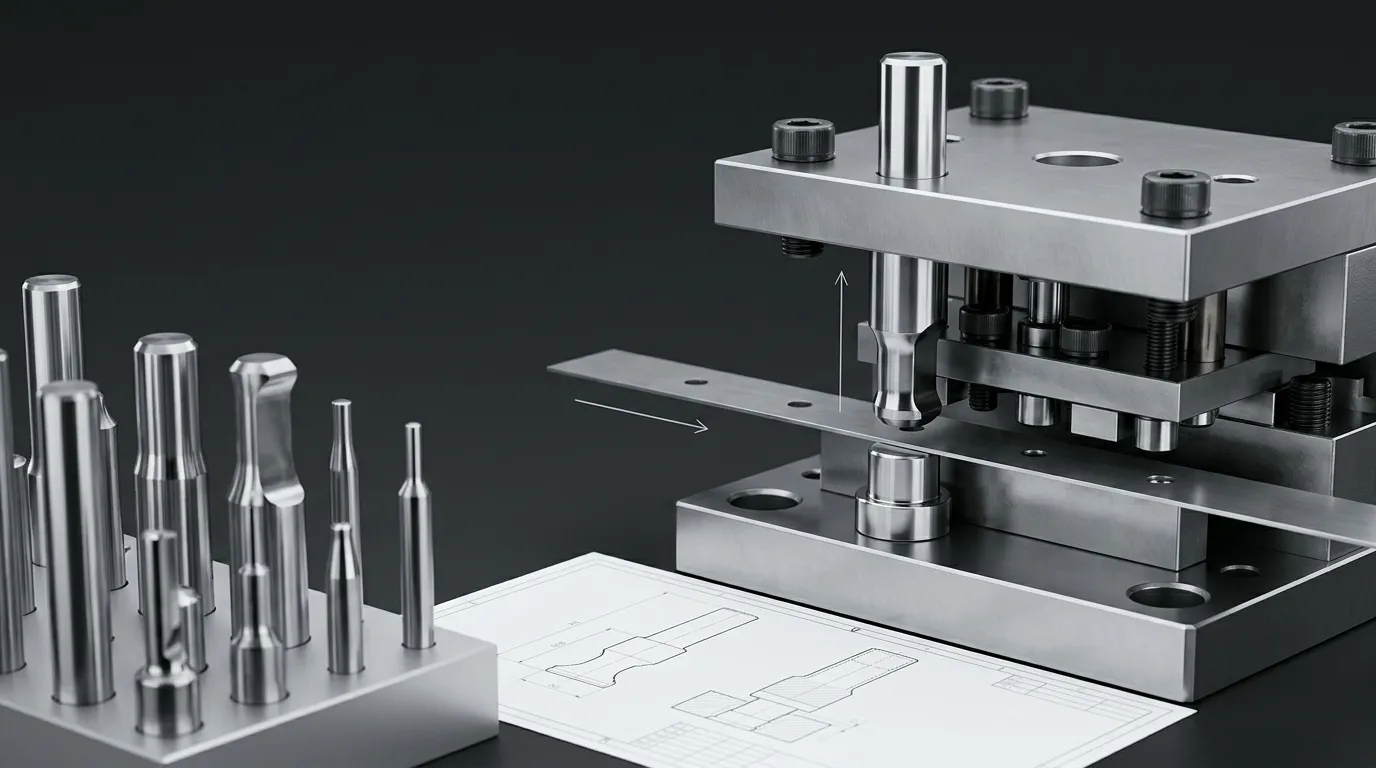
Dlaczego progresywne matryce potrzebują specyfikacji wybijaczy specyficznych dla stacji
A progressive die moves strip material through a sequence of stations. Each press stroke may pierce, notch, trim, Forma, or separate a feature while the feeder and pilots maintain the strip’s position.
This creates several demands that are less significant in a simple single-operation die:
- Errors at one station can affect every station that follows.
- Repeated side loading can gradually deflect a punch even before visible failure occurs.
- Feed or pilot errors can move the strip relative to the punch.
- Stripping force loads the punch during withdrawal from the stock.
- Slugs or loose material can interfere with later operations.
- Regrinding one punch can alter penetration or timing relative to other stations.
“High-cycle” therefore describes an operating condition, not a guaranteed number of strokes. Actual punch life depends on the complete combination of material, Geometria, Dostęp, Warunki prasowe, Smarowanie, Wsparcie, oraz konserwację.
Dopasuj dziurk do operacji na każdej stacji
The first selection question should be: What does this punch do at its station?
Different operations create different loading patterns.
| Eksploatacja stacji | Główne zapotrzebowanie na uderzenia | Typowe ryzyka do oceny |
|---|---|---|
| Przekłucie | Powtarzające się ścinanie przez zamknięty profil | Zużycie krawędzi, small-section breakage, slug pulling, Wzrost żarna |
| Nacięcie lub przycinanie | Ścinanie wzdłuż krawędzi pasa lub częściowego konturu | Asymmetric load, side deflection, nierówne zużycie |
| Cutoff | Ostateczne rozdzielenie części lub nośnika | High separation load, timing sensitivity, shock |
| Powstawanie | Odkształcenie plastyczne zamiast zwykłego ścinania | Side thrust, Przepływ materiałów, irytujące, profile wear |
| Pilotaż | Rejestracja pasków zamiast wycinania cech | Position error, pilot entry damage, feed mismatch |
A small round piercing punch, na przykład, may be limited by slenderness and slug behavior. A long trimming profile may be more sensitive to uneven loading across its edge. A forming punch may need greater resistance to lateral force and material pickup.
Działające dziurkacze i sworznie pilotowe wykonują różne zadania
A working punch cuts or forms the strip. A pilot pin enters a previously produced hole or locating feature to refine strip position before critical operations occur.
The terms are sometimes mixed in supplier catalogues, so the drawing and RFQ should state the function clearly. The Standard terminologii dziurkaczy ISO 8695 can help distinguish recognized punch types, while pilot design still needs to reflect strip thickness, feed conditions, and the actual locating method.
A pilot should not be selected using the same assumptions as a piercing punch. Its entry shape, Lokalizacja, Dostęp, and relationship with the feeder are central to its function.
Specify Geometry, Support, and Alignment as One System
Punch geometry cannot be evaluated only by nominal diameter or overall length. The designer must consider the smallest working section, profile transitions, Shank, głowa, Długość bez podparcia, Metoda retencji, and mating die opening.
For a reliable specification, Recenzja:
- working-tip diameter or profile;
- smallest cross-section;
- unsupported length below the guide or holder;
- shank and head dimensions;
- transition radii where the part design allows them;
- straightness and relevant runout;
- concentricity between the working end and shank;
- profile tolerance for non-round punches;
- edge condition and regrind allowance;
- functional datums for replacement inspection.
A punch that is strong in compression can still fail if it is long, smukły, poorly guided, or exposed to lateral load.
Sztywność dziurka sterującego wybijakiem przy profilu i niepodpartym długości
As unsupported punch length increases, resistance to deflection decreases. Narrow slots, small diameters, sharp profile changes, and asymmetric cutting edges further increase stress concentration.
Side loading is especially damaging because it can move the punch tip away from the intended axis. This changes the effective clearance around the profile. One side may then carry more cutting load, causing uneven wear or local chipping.
Wskazówki techniczne dotyczące Poprawa żywotności punchu also connects lateral loading with punch-tip deflection and altered cutting clearance. This is why repeated breakage should not automatically lead to a harder punch material. The underlying problem may be geometry, Wsparcie, feed position, or station loading.
The Holder, Backing Plate, Stripper, and Die Button Must Agree
The punch operates through a stack of supporting components:
| Składnik | Związek z ponczem | Problemy, jeśli relacja jest słaba |
| Uchwyt na dziurkacz lub retainer | Lokalizuje i zabezpiecza trzon | Position error, Luzność, repeated misalignment |
| Płyta podkładowa | Wspiera głowicę dziurkarza pod obciążeniem osiowym | Head indentation, Słabe miejsca siedzące, local overload |
| Płyta zdejmująca | Usuwa materiał i może prowadzić koniec roboczy | High withdrawal load, tip movement, Punktacja |
| Przycisk kostki lub matryca | Odbiera uderzenie i ustanawia otwór do cięcia | Uneven clearance, edge damage, Wariacja burra |
| Słupki drogowe i tuleje | Utrzymanie ustawienia od góry do dolnej części matrycy | Off-center entry, Jednostronne zużycie, odpryskiwanie |
A guided stripper can help maintain the punch tip’s relationship with the die opening. Techniczne wyjaśnienie struktur matryc w MISUMI notes the use of movable strippers for precision and progressive punching, including punch-tip guidance.
The wider roles of holders, backing plates, Striptizerki, die buttons, and guide systems are covered in the Przewodnik po komponentach matrycy. For this application, the important point is that changing only the punch may not solve a support or alignment problem.
Control Clearance, Strip Registration, and Slug Movement
The punch and die opening form a working pair. Their relationship affects cutting load, fracture behavior, Formowanie żarna, edge wear, oraz ruch ślimaków.
Clearance should be based on the actual:
- Materiał obrabianego;
- strip thickness;
- hardness or strength;
- feature geometry;
- required edge condition;
- punch and die material;
- alignment capability;
- expected wear behavior.
A nominal clearance value is not enough if the punch deflects or the die set is misaligned. The effective clearance may become larger on one side and smaller on the other.
Zezwolenie musi odpowiadać materiałowi i cechom
There is no single clearance percentage suitable for every progressive-die station.
Research on blanking has shown that clearance can influence punch wear, burr size, and the geometry of the cut feature. Jeden Recenzowane badanie dotyczące hartowanej blachy stalowej found measurable relationships among blanking clearance, Zużycie dziurkowe, and burr development under its tested conditions.
The practical lesson is not to copy the study’s values into an unrelated die. Instead, use the material grade, Grubość, Siła, Geometria, and quality requirement to establish a starting condition, then verify it through controlled inspection.
Uneven wear around the punch should trigger checks for:
- off-center punch entry;
- worn guide components;
- punch deflection;
- die-button movement;
- feeder or pilot error;
- uneven cutting load;
- local edge damage.
Rejestracja i kontrola ślimaków chronią stacje poniżej linii
Progressive tooling depends on repeatable strip positioning.
A typical sequence is:
- The feeder advances the strip by the intended pitch.
- Pilots refine or confirm strip position.
- The stripper controls the stock near the working area.
- The punch enters the strip and die opening.
- The slug or trimmed material clears the station.
- The stripper removes the stock from the punch during return.
A feed or pilot problem can cause the punch to engage the strip off-center. Excessive stripping force can bend a slender punch or loosen its retention. A returned slug can remain on the punch face, re-enter the strip, or interfere with a later station.
Slug pulling therefore should not be treated only as a waste-removal issue. It can become a punch-damage and strip-progression problem.
Wybierz materiał i powłokę według dominującego ryzyka awarii
Punch material should be selected after identifying the expected loading and failure mode. Maximum hardness alone is not a reliable selection method.
The main properties to balance are:
- Odporność na zużycie;
- Wytrzymałość;
- Wytrzymałość ściskająca;
- resistance to plastic deformation;
- dimensional stability after heat treatment;
- resistance to chipping under shock or side load;
- suitability for the intended coating and finish.
Wybierz podłoże przed powłoką
| Warunek aplikacji | Kierunek materiałowy do oceny | Główne ograniczenie do sprawdzenia |
| Umiarkowane zużycie przy obciążeniu uderzeniowym lub zmiennym | Kategoria stali narzędziowej lub stali szybkościącowej | Może się szybciej zużywać niż bardziej odporna na zużycie opcja |
| Mocne zużycie ścierne przy stabilnym ustawieniu | Higher-wear tool steel, powder-metallurgy steel, lub węglik | Koszty, Szlifowanie, odpryskiwanie, and support requirements |
| Mały wybiór z powtarzającym się obciążeniem bocznym | Twardsza stal i lepsze prowadzenie | Zużycie może wzrosnąć, jeśli podłoże jest zbyt miękkie |
| Stable, high-wear piercing condition | Można rozważyć węglik | Sensitive to shock, Niedopasowanie, and inadequate support |
| Zużycie kleju lub przechwyt | Suitable substrate plus finish, Smarowanie, or coating review | Powłoka nie jest w stanie skorygować błędów geometrycznych ani przerywów |
Carbide can provide high wear resistance and compressive strength, but it is not automatically the best choice for every station. A carbide punch exposed to misalignment, shock, or side loading may chip where a tougher steel would tolerate the same disturbance.
SunshinePro lists SKH51, SKH9, DC53, ASP grades, and carbide among its punch-pin material categories. These are available directions, not proof that one grade is suitable for a specific die. The final choice requires the work material, Geometria, Wsparcie, Warunki produkcyjne, and failure history.
Zastosowanie powłok do zdefiniowanego problemu powierzchniowego
A coating should target a known surface issue such as abrasive wear, Zużycie kleju, irytujące, lub odbioru materiału.
Before selecting one, potwierdź:
- punch substrate and heat treatment;
- surface finish before coating;
- coating adhesion requirements;
- workpiece material and surface condition;
- Smarowanie;
- Temperatura pracy;
- whether the punch will be reground;
- whether the coated surface includes the cutting edge, sidewall, albo obu.
SunshinePro lists TiN, TiCN, and DLC as custom punch-pin coating options. The appropriate choice depends on the substrate and contact conditions. No coating can correct an off-center punch, Niewystarczające wsparcie, weak profile, or incorrect punch-to-die relationship.
Zdiagnozuj zużycie i uszkodzenia przed wymianą wybijaka
The visible damage is not always the root cause. A symptom-based inspection reduces the risk of replacing the punch while leaving the system problem unchanged.
| Objawy | Możliwe zmienne | Pierwsze sprawdzenia |
| Burr stopniowo rośnie | Zużycie krawędzi, die wear, clearance change | Inspect punch edge, Otwarcie, feature quality trend |
| Zużycie pojawia się głównie po jednej stronie | Deflection, Niedopasowanie, feed error, uneven clearance | Check guides, pilots, holder position, die-button alignment |
| Lokalnie chipy krawędziowe | Shock, Nadmierne obciążenie, słabe wsparcie, low toughness, tight local clearance | Inspect fracture location, punch support, Otwarcie, Kierunek obciążenia |
| Wygięcia lub wygięcia dziurków | Nadmierna długość bez podparcia, small section, Boczne obciążenie, przeciążenie | Check profile, Wskazówki, station operation, strip position |
| Materiał dobrze przylega do wybicia | Galling, słabe smarowanie, finish issue, Nieodpowiednia powłoka | Inspect pickup pattern, stock surface, Smarowanie, sidewall finish |
| Punch head zawodzi | Poor seating, weak backing support, Stężenie naprężeń, przeciążenie | Check holder, Płyta podkładowa, Geometria głowicy, Wzór kontaktowy |
| Pocisk podąża za ciosem | Przyczepność, vacuum effect, poor slug relief, Stan twarzy uderzeniowej | Inspect slug path, die relief, punch face, Smarowanie |
| Dryfy pozycji obiektu | Feed, pilot, Przewodnik, posiadacz, or punch movement | Check strip pitch, pilot condition, holder fit, die alignment |
Repeated fracture deserves a broader investigation. The dedicated guide to Pęknięcie dziurkownika w matrycach tłoczących covers fracture causes and preventive actions in more depth.
A practical rule is to inspect the mating and supporting components whenever the same punch fails again. Replacing a damaged punch with an identical one will not correct a worn die button, loose holder, unstable feeder, damaged stripper, or misaligned guide system.
Plan Regrinding, Inspekcja, and Interchangeable Replacement
Regrinding restores the cutting edge, but it also removes punch length. That change can affect penetration, stripper interaction, station timing, and the relationship with other punches.
A maintenance plan should define:
- the condition that triggers sharpening;
- allowable stock removal;
- original and remaining punch length;
- edge geometry after grinding;
- required straightness or runout;
- whether coating must be reapplied;
- inspection of the mating die button;
- timing or penetration adjustment after installation;
- the minimum remaining serviceable length.
Do not wait for severe chipping if the punch is intended to be reground. Grinding away extensive damage removes more material and may make it harder to preserve the original profile.
Replacement punches also need functional datums. A drawing should identify which surfaces control:
- position in the holder;
- working-tip location;
- head seating;
- overall operating length;
- profile orientation;
- relationship with the mating die opening.
SunshinePro states that its quality approach includes incoming inspection, Monitorowanie w trakcie procesu, Testy końcowe, and inspection reporting. For an actual order, the buyer should still define which dimensions, Data, Tolerancje, and report fields must be verified.
Wybierz standardowy lub niestandardowy sworzeń do dziurkowania
A standard punch may be suitable when the required profile, Wymiary, Styl głowy, Metoda retencji, Materiał, and tolerances match an available design.
A custom punch is more likely to be required when the station uses:
- a non-round or proprietary profile;
- an unusual head or retention interface;
- a stepped or reduced working section;
- a special transition between shank and tip;
- an orientation feature;
- tight relationships between several datums;
- replacement dimensions tied to an existing die;
- a specific material, Obróbka cieplna, or coating combination.
| Pytanie dotyczące wyboru | Standardowy dziurk może pasować | Może być potrzebny niestandardowy dziurkacz |
| Is the working profile common? | Profil katalogowy okrągły lub ustalony | Special slot, contour, Krok, or asymmetric shape |
| Is the holder interface standard? | Wspólna konfiguracja głowicy i trzonka | Opatentowana geometria zatrzymania lub siedzenia |
| Are replacement datums simple? | Podstawowa kontrola średnicy i długości | Multiple positional, Profil, or orientation controls |
| Is the material readily available in the required form? | Standardowa klasa zabytkowa | Special grade, carbide form, or treatment requirement |
| Does the punch match an existing die? | Standardowe wymiary już stosowane | Wymagana jest dokładna wymiana kompatybilności |
A worn sample can help identify the component, but it may not preserve the original dimensions. Zużycie, regrinding, bending, and edge damage can all distort the sample. A controlled drawing remains the preferred reference.
SunshinePro states that custom punch pins can be produced from drawings, Próbki, or specifications, with custom dimensions, Kształty, head profiles, Materiały, oraz powłoki. Its published processes include CNC machining, precyzyjne szlifowanie, Obróbka cieplna, Obróbka próżniowa, and EDM. Feasibility still needs to be confirmed for the specific geometry and tolerance combination.
Przygotuj Rysunek i pakiet RFQ
A complete inquiry helps the supplier evaluate material, Trasa produkcyjna, inspekcja, and replacement requirements without guessing.
Zawiera:
- punch drawing and revision;
- station function: Przekłucie, trimming, Tworzenie, cutoff, or piloting;
- strip material grade;
- strip thickness;
- workpiece hardness or strength where relevant;
- stock coating or surface condition;
- working profile and feature dimensions;
- mating die-button dimensions or intended clearance;
- Shank, głowa, Utrzymanie, and orientation details;
- functional datums;
- dimensional and geometric tolerances;
- required surface finish;
- Stan krawędzi;
- punch material and heat-treatment requirements;
- coating requirement, if already defined;
- unsupported length and guidance arrangement;
- press speed or production rate;
- Przewidywana produkcja;
- Warunki smarowania;
- known failure symptoms;
- regrinding and spare-punch requirements;
- material certificate, Rekord obróbki cieplnej, coating record, or inspection-report requirements.
Published tolerance or hardness ranges should not be copied into the RFQ without checking whether they suit the drawing. SunshinePro’s punch pages publish capability ranges up to ±0.002 mm and HRC 58–68, but the achievable combination depends on punch size, Profil, Materiał, Obróbka cieplna, Powłoka, oraz metodę inspekcji.
The most useful supplier question is not “How many cycles will this punch last?” without operating data. Ask the supplier to review the station conditions, identify manufacturing or inspection risks, and confirm the proposed material, Geometria, and tolerance approach.
For a drawing-based feasibility review or quotation, submit the punch specification, strip information, station function, and known failure history through the Strona kontaktowa SunshinePro.
Udostępnij:



Napisane przez Sunshine
W Sunshine, Jesteśmy profesjonalnym producentem i dostawcą komponentów do precyzyjnych form, oferując szeroką gamę produktów do tłoczenia i formowania wtryskowego. Naszym głównym celem są formy do dziurkania, Sworznie wyrzutowe i tuleje, oraz słupy i tuleje. Dzięki zaawansowanej obróbki CNC, Ścisła kontrola jakości, oraz silne możliwości produkcyjne, Zapewniamy niezawodność, Części o wysokiej precyzji, wraz ze standardowymi komponentami dostępnymi na stanie, zapewniającymi szybkie i efektywne globalne dostawy.
WIADOMOŚCI
UZYSKAJ USŁUGĘ
Z wysokiej jakości częściami dostosowanymi do każdego budżetu oraz przyjaznym personelem przeszkolonym, by Twoja wizyta była poinformowana i bezproblemowa.
