



Wytyczne dotyczące formowania wtryskowego: Konstrukcja, Narzędzia, oraz najlepsze praktyki produkcyjne
Injection molding guidelines should be reviewed before tooling starts, not after steel is cut. The most important best practices include maintaining uniform wall thickness, adding proper draft angles, designing ribs and bosses carefully, setting realistic tolerances, and running a full DFM review early. Teams that validate manufacturability before tooling approval reduce revision costs, shorten lead times, oraz poprawę spójności produkcji.
Injection molding problems usually start long before production begins. A part may look fine in CAD, then fail during sampling because of sink marks, poor ejection, unstable tolerances, or expensive tooling revisions. This guide focuses on the practical rules buyers and engineers should check before approving tooling, especially when schedules, production scale, and supplier coordination all matter.
What are the most important injection molding guidelines before tooling starts?
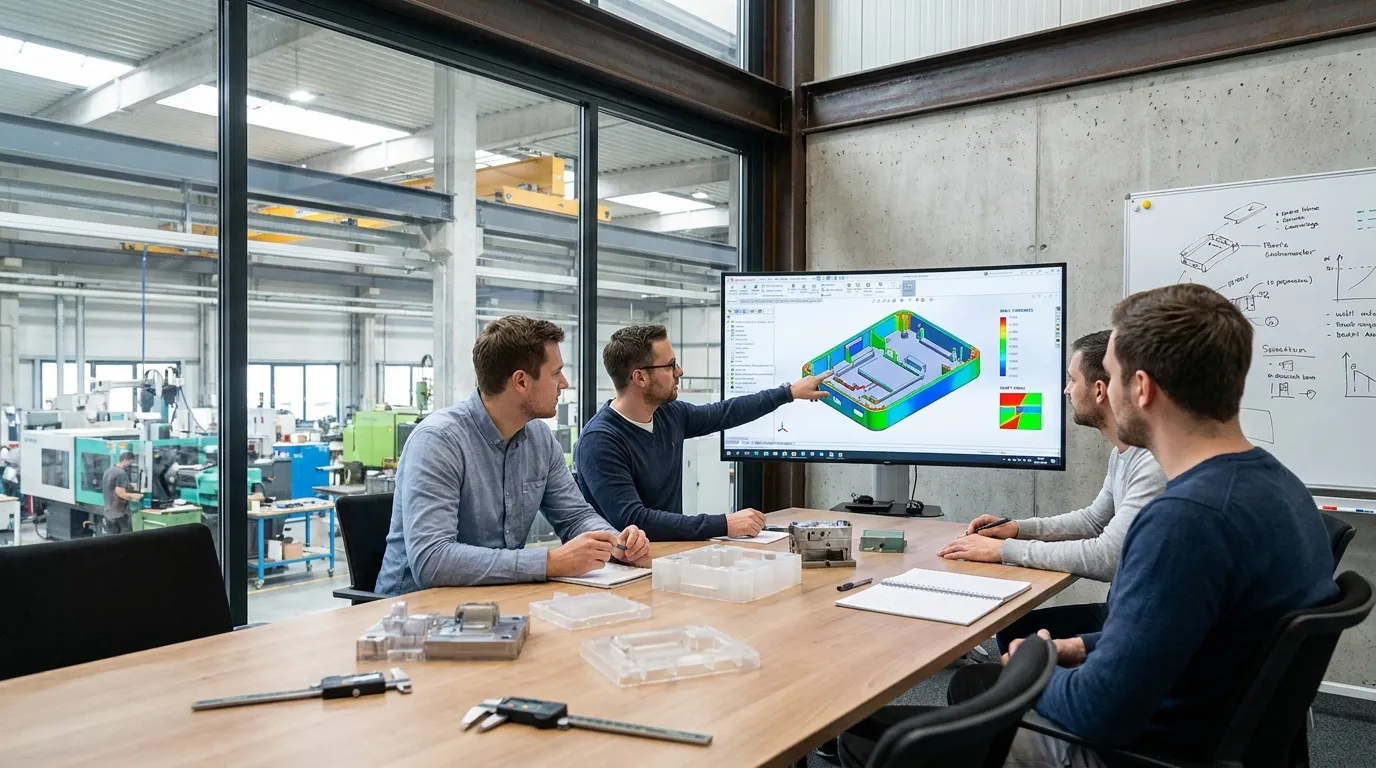
Injection molding guidelines should focus on moldability before steel cutting begins. Jednolita grubość ścianek, Właściwe kąty zanurzenia, Realistyczne tolerancje, and early DFM review reduce tooling revisions, shorten lead times, oraz poprawę spójności produkcji.
The most expensive injection molding mistakes usually happen during the design approval stage. Once tool steel is cut, even small geometry changes can delay production and increase cost. That’s why early manufacturability review matters more than rushing into tooling.
Start by reviewing wall thickness consistency, Kąty draftu, Kurczenie się materiału, Rozmieszczenie bramek, and assembly features. A good supplier should also provide a full Proces przeglądu DFM Przed zatwierdzeniem narzędzi.
The cheapest tooling quote is not always the lowest production cost. Suppliers that skip detailed DFM analysis often create more expensive revisions later, especially when defects appear during T1 sampling.
For teams that need broader background on tooling systems and mold terminology, to Kompletny przewodnik po formie wtryskowej provides a full overview.
Lista kontrolna zatwierdzania przed zatwierdzeniem narzędzi
| Obszar przeglądu | Co potwierdzić |
|---|---|
| Grubość ścianek | Spójne przekroje w całej części |
| Kąty draftu | Wystarczający ciąg do czystego wyrzucenia |
| Wybór materiałów | Żywica odpowiada potrzebom wytrzymałości i skurczu |
| Rozmieszczenie bramek | Zrównoważone wypełnienie i kontrola kosmetyczna |
| Tolerancje | Tylko wymiary krytyczne są ciasne |
| Konstrukcja żeber i wypycha | Brak powiększonych funkcji wsparcia |
| Recenzja DFM | Dostawca przeanalizował ryzyka formowalności |
| Plan próbkowania | T1 i harmonogram rewizji uzgodnione |
How do wall thickness and draft angles affect moldability?
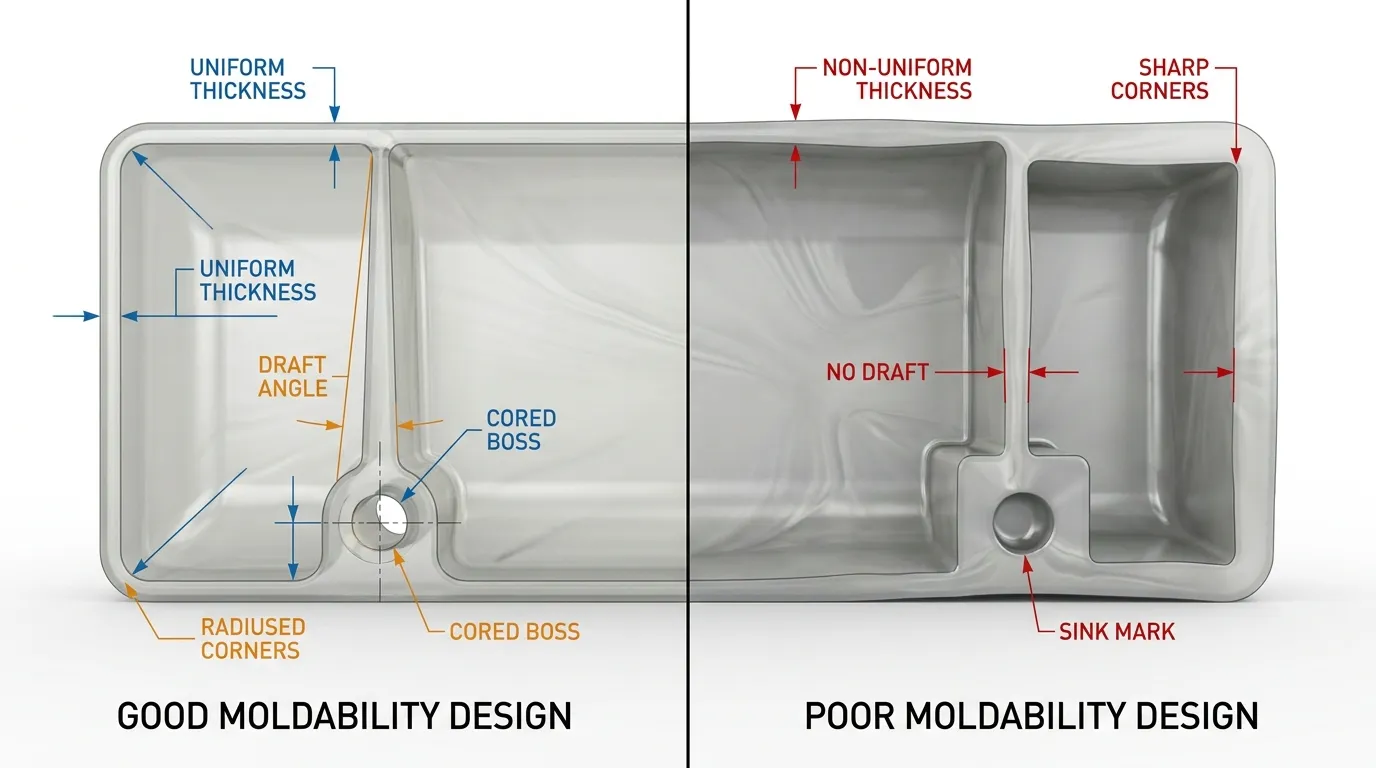
Wall thickness and draft angle directly affect filling, Chłodzenie, oraz wyrzucenie. Consistent wall sections reduce warpage, while sufficient draft angles help parts release cleanly and reduce cosmetic damage during production.
Wall thickness controls how plastic flows and cools inside the mold. Thick sections cool more slowly, which can create sink marks, voids, lub nierównomierne kurczenie się. Thin sections may fail to fill properly if the material freezes too quickly.
Obudowa elektroniki użytkowej jest częstym przykładem. One side may look clean after molding, while another develops visible sink marks because internal ribs created thick cooling zones behind the cosmetic surface.
Według Przewodnik po formowaniu wtryskowym piast oraz Przewodnik projektowy Fictiv po formowaniu wtryskowym, maintaining uniform wall thickness helps reduce warpage and improves production stability.
Zalecane zakresy grubości ścianek
| Typ części | Ogólne wytyczne |
|---|---|
| Małe części konsumenckie | Thin, uniform walls |
| Obudowy konstrukcyjne | Umiarkowana grubość z wsparciem żeber |
| Duże panele kosmetyczne | Zrównoważona grubość, aby zmniejszyć odkształcenia |
| Elementy przemysłowe o wysokiej wytrzymałości | Reinforcement through geometry, not excessive wall thickness |
Wytyczne dotyczące kątów szkicu dla części teksturowanych i nieteksturowanych
Draft angles help parts eject cleanly from the mold. Most molded parts need at least 1 to 2 degrees of draft per side. Textured surfaces often require more because the texture increases friction during ejection.
An automotive trim supplier may increase draft angles after testing textured surfaces. Without extra draft, cosmetic drag marks can appear during ejection, especially on deep features or glossy parts.
If you're refining geometry for manufacturability, ten przewodnik o Geometria części plastikowych covers additional design considerations.
What are the best practices for ribs, Bossowie, and corners?
Ribs and bosses should strengthen parts without creating thick sections that cool unevenly. Gradual transitions, reinforced bosses, and proper rib thickness help prevent sink marks and stress concentration.
Ribs are often better than thick walls when additional stiffness is needed. Thick plastic sections cool unevenly and create visible defects. Properly sized ribs strengthen the part while maintaining more consistent cooling behavior.
Bosses also need careful support. Unsupported bosses may crack during assembly or distort during molding. A startup hardware company may delay tooling approval after a DFM review identifies unsupported screw bosses near a thin wall section.
Lista kontrolna projektu żeber i wygłębków
- Utrzymuj grubość żeber mniejszą niż sąsiednia ściana
- Dodaj polędwicze u podstawy żeber, aby zmniejszyć stężenie naprężeń
- Wzmacniaj wysokie bossy żebrami wspierającymi
- Unikaj ostrych narożników zakłócających przepływ materiału
- Stosuj stopniowe przejścia między sekcjami ścian
Corners matter more than many teams expect. Sharp internal corners increase stress and interrupt flow. Rounded transitions help material move more evenly through the cavity and reduce cracking risk later.
For more detailed feature planning, this resource on Projektowanie cech form explains how mold structures interact with part geometry.
How should material selection influence part design?
Material selection affects shrinkage, Tolerancje, Zachowanie chłodzenia, and mold design requirements. Teams should match resin properties to both product performance and manufacturability goals before tooling approval.
Material choice affects much more than strength. Different resins shrink differently during cooling, respond differently to heat, and require different processing conditions. Those variables directly influence tooling design and production consistency.
A material with higher shrinkage may require additional compensation during mold design. Another resin may need tighter process control to maintain cosmetic quality or dimensional stability.
Tabela decyzyjna dotycząca wyboru materiału
| Priorytet projektowy | Rozważania materialne |
|---|---|
| Wykończenie kosmetyczne | Jakość powierzchni i zachowanie przepływu |
| Odporność na ciepło | Stabilność termiczna podczas użytkowania |
| Wytrzymałość konstrukcyjna | Odporność na uderzenia i sztywność |
| Ścisłe tolerancje | Przewidywalne zachowanie kurczenia się |
| Użytkowanie na zewnątrz | Odporność na promieniowanie UV i środowisko |
Tight tolerances should not be treated as default engineering practice. Many injection molded parts perform well with standard production tolerances and lower tooling complexity. Over-specifying precision often increases cost without improving functional performance.
Ten przewodnik o Rozważania dotyczące przetwarzania materiałów explains how resin behavior affects production conditions and mold setup.
What tolerance guidelines prevent unnecessary tooling cost?
Tight tolerances increase tooling complexity, Wymagania dotyczące inspekcji, and process variability. Most injection molded parts should use standard production tolerances unless the application requires critical precision features.
Every tolerance should have a reason behind it. Tight dimensions increase machining precision, mold complexity, Monitorowanie procesów, oraz wymagania inspekcyjne. They may also reduce production yield during high-volume manufacturing.
Many buyers unknowingly create unnecessary tooling costs by applying precision tolerances across an entire part instead of limiting them to functional areas.
Tabela porównawcza tolerancji
| Strategia tolerancji | Wpływ na produkcję |
|---|---|
| Standardowa tolerancja produkcyjna | Niższe koszty narzędzi i szybsze próbkowanie |
| Ścisła tolerancja kosmetyczna | Więcej polerowania i inspekcji |
| Ścisła tolerancja montażu | Wymagana jest wyższa precyzja narzędzi |
| Ścisła tolerancja na całej części | Zwiększona zmienność produkcji |
A connector housing may only need critical tolerances around mating features. The outer housing surfaces often do not require the same precision. Restricting tight tolerances to functional areas helps maintain reasonable tooling cost and production efficiency.
If your team is balancing cost against manufacturability, this article on Planowanie tolerancji produkcyjnych provides additional DFM guidance.
What should a proper injection molding DFM review include?
A proper DFM review checks whether the part can fill, Fajnie, eject, and maintain tolerances consistently during production. It should identify geometry risks before mold steel is cut.
A strong DFM review is one of the best ways to prevent tooling revisions. It helps suppliers identify molding risks before machining begins, when changes are still manageable and affordable.
Według Narzędzie projektowania Protolabs do formowalności, DFM analysis should evaluate geometry, Zachowanie materiału, Rozmieszczenie bramek, Sprawność chłodzenia, and ejection performance.
Podstawowe obszary przeglądu DFM
- Umieszczenie bram i przepływ materiałów
- Stabilność chłodzenia w całej komorze
- Walidacja kąta wyrzutu i kąta zanurzenia
- Ślad zapadnięcia i ryzyko odkształcenia
- Recenzja geometrii żeber i wypukłych
- Rozmieszczenie linii rozdzielającej
- Wykonalność tolerancji
A common production delay happens when teams approve tooling before reviewing gate placement carefully. A later gate relocation may require re-machining steel and extending the sampling timeline by several weeks.
Speed-focused tooling schedules can also create unstable production launches if revision planning is compressed too aggressively. Fast timelines work best when designs are already mature and fully reviewed.
Pytania, które kupujący powinni zadać podczas zatwierdzania DFM
- Which areas are highest risk for sink or warpage?
- Are any features difficult to eject?
- Which dimensions are difficult to maintain consistently?
- Will cosmetic surfaces require additional draft?
- What revisions become expensive after steel cutting?
For a deeper review workflow, ten przewodnik o Analiza DFM formowania wtryskowego expands on manufacturability evaluation methods.
Which supplier questions prevent production delays?
Buyers should evaluate how suppliers handle DFM feedback, sampling revisions, Konserwacja pleśni, oraz zwiększenie produkcji. These operational details often affect timelines more than quoted tooling cost alone.
A supplier may offer competitive tooling pricing but still struggle during production ramp-up. Questions about workflow, Komunikacja, and revision handling often reveal more about long-term reliability than the initial quote.
Ask suppliers how they manage T1 sampling, Poprawki narzędzi, preventive maintenance, and process validation. Mold maintenance planning matters because worn tooling can affect consistency over long production runs.
Lista kontrolna oceny dostawców
| Pytanie | Dlaczego to ważne |
|---|---|
| How are DFM revisions handled? | Zapobiega zamieszaniu związanemu z zatwierdzeniem |
| What is the T1 sampling timeline? | Ustala realistyczne oczekiwania dotyczące harmonogramu |
| What press sizes are available? | Potwierdza kompatybilność produkcyjną |
| How are tooling repairs managed? | Zmniejsza ryzyko przestojów |
| What quality checks are standard? | Poprawia spójność |
A supplier with a slightly longer lead time may still be the safer option if their DFM communication is stronger and their sampling process is more organized.
To ten przegląd Etapy przepływu pracy produkcji helps buyers understand how supplier coordination affects production readiness.
What production and sourcing risks should teams plan for?
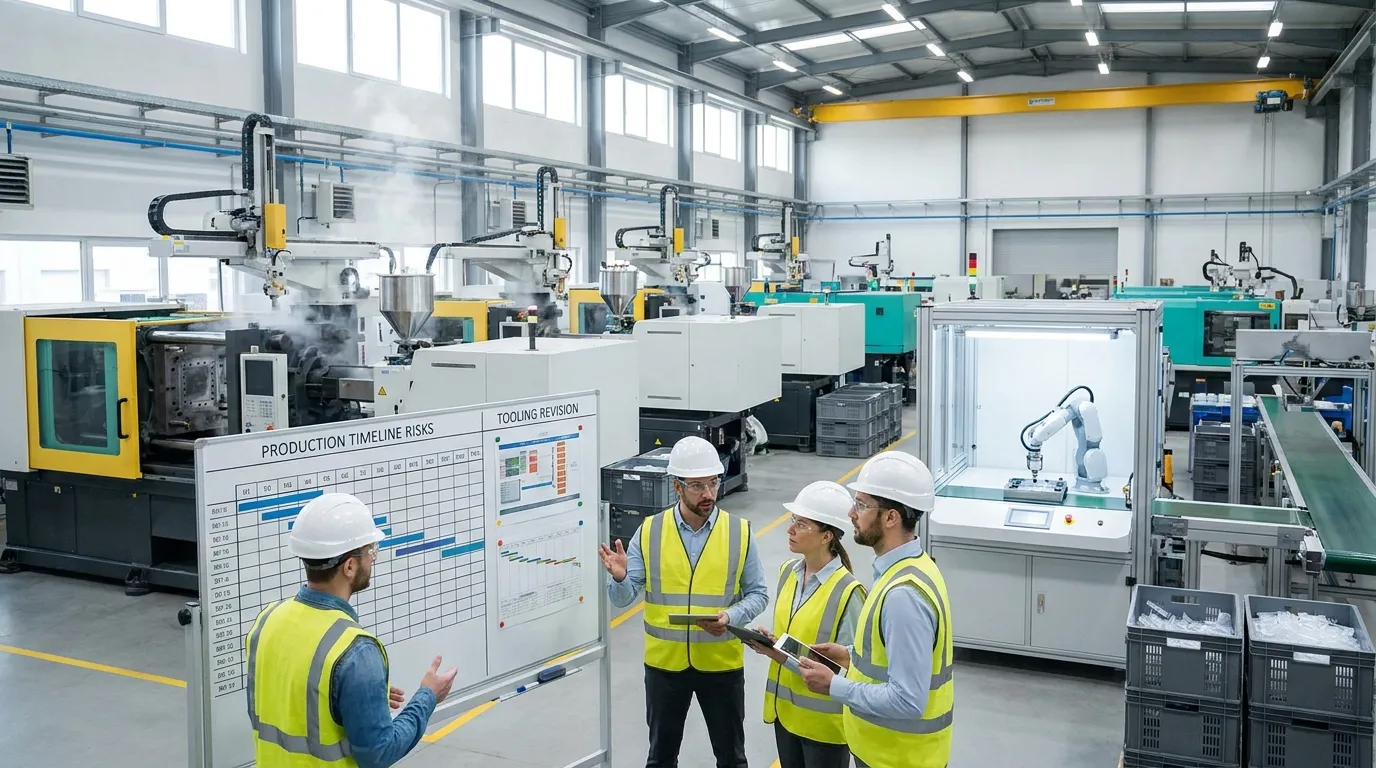
Injection molding timelines often slip because of tooling revisions, Opóźnione zatwierdzenia, Kontrole celne, or unstable production ramp-up after sampling. Early planning reduces both cost risk and launch delays.
Most project delays happen after teams assume tooling is already “finished.” In reality, Próbkowanie, Poprawki, Żegluga, and production transfer can still create schedule instability long after steel cutting begins.
A post-steel design revision is one of the most expensive timeline disruptions. Even changing gate placement or adjusting a cosmetic feature may require reworking mold steel and restarting validation.
Dlaczego zmiany w projektowaniu po produkcji stali powodują kosztowne opóźnienia
A medical enclosure project may pass initial CAD approval, then fail cosmetic review after T1 sampling. The revised gate location improves surface quality but adds several weeks to the tooling schedule because the cavity needs machining updates.
Those delays become more serious when overseas tooling shipments, Odprawa celna, or tariff-related inspections are involved. Raporty branżowe z Aprios oraz aktualizacje dotyczące wysyłki omawiane przez Listwy BAP show how lead times can extend when production transfer and logistics planning are weak.
Tabela ryzyka opóźnienia formowania wtryskowego
| Źródło ryzyka | Typical Cause | Wpływ na oś czasu | Krok zapobiegawczy |
|---|---|---|---|
| Rewizja narzędzi | Późna zmiana geometrii | Wielotygodniowe opóźnienie | Zakończ DFM jak najwcześniej |
| Kontrola celna | Niekompletna dokumentacja | Opóźnienie w dostawie | Sprawdź dokumentację |
| Słaby plan próbkowania | Niejasny proces zatwierdzania | Cykle powtarzające się próbkowanie | Zdefiniuj oczekiwania T1 |
| Zmiany materialne | Problem dostępności żywicy | Wymagana ponowna walidacja | Wczesny wybór materiału zamka |
| Transfer produkcji | Niespójne ustawienie procesu | Niestabilność startupu | Standaryzuj sterowanie procesami |
An overseas tooling shipment may also face customs delays if sample declarations or commercial documentation are incomplete. Those risks are often ignored during early sourcing discussions, even though they directly affect launch schedules.
For teams managing supplier timelines, this guide to the Harmonogram od narzędzi do produkcji explains how production stages connect from tooling approval through manufacturing ramp-up.
Poprawne wykonanie kolejnego kroku
Good injection molding guidelines are less about memorizing technical rules and more about making better production decisions before tooling starts. Teams that validate wall thickness, Draft, Tolerancje, Materiały, and DFM feedback early usually avoid the most expensive revisions later.
Przed zatwierdzeniem narzędzi, Przejrzyj ten element zarówno z perspektywy inżynierii, jak i produkcji. Ask suppliers difficult questions, challenge unnecessary tolerances, and confirm how revisions will be handled if sampling uncovers problems. Small decisions during design review often determine whether production stays stable or becomes expensive to fix later.
Najczęściej zadawane pytania
What is the ideal wall thickness for injection molding?
The ideal wall thickness depends on the resin and part geometry, but consistency matters more than absolute thickness. Uniform walls reduce warpage, ślady zapadnięcia, and cooling imbalance during production.
How much draft angle is recommended for injection molded parts?
Most injection molded parts need at least 1 to 2 degrees of draft per side for smooth ejection. Textured surfaces and deeper features usually require additional draft to prevent drag marks and cosmetic damage.
Dlaczego DFM jest ważne w formowaniu wtryskowym?
DFM helps manufacturers identify filling, Chłodzenie, Wyrzucenie, and tolerance risks before tooling begins. Early DFM review reduces revision costs and prevents avoidable production delays during sampling and ramp-up.
Jak długo trwa zbudowanie formy wtryskowej?
Production mold lead times commonly range from several weeks to several months depending on geometry, Ubytki, finish requirements, oraz zmiany w narzędziach. Design changes after steel cutting usually extend schedules further.
Co powoduje ślady po zlewaniu podczas formowania wtryskowego?
Sink marks usually occur when thick sections cool unevenly or ribs and bosses are oversized. Consistent wall thickness and gradual transitions help reduce the risk during molding.
What questions should buyers ask an injection molding supplier?
Buyers should ask about DFM review process, sampling workflow, press capability, Obsługa wersji, and mold maintenance planning. These factors strongly influence production stability and lead time reliability.
Udostępnij:



Napisane przez Sunshine
W Sunshine, Jesteśmy profesjonalnym producentem i dostawcą komponentów do precyzyjnych form, oferując szeroką gamę produktów do tłoczenia i formowania wtryskowego. Naszym głównym celem są formy do dziurkania, Sworznie wyrzutowe i tuleje, oraz słupy i tuleje. Dzięki zaawansowanej obróbki CNC, Ścisła kontrola jakości, oraz silne możliwości produkcyjne, Zapewniamy niezawodność, Części o wysokiej precyzji, wraz ze standardowymi komponentami dostępnymi na stanie, zapewniającymi szybkie i efektywne globalne dostawy.
WIADOMOŚCI
UZYSKAJ USŁUGĘ
Z wysokiej jakości częściami dostosowanymi do każdego budżetu oraz przyjaznym personelem przeszkolonym, by Twoja wizyta była poinformowana i bezproblemowa.
